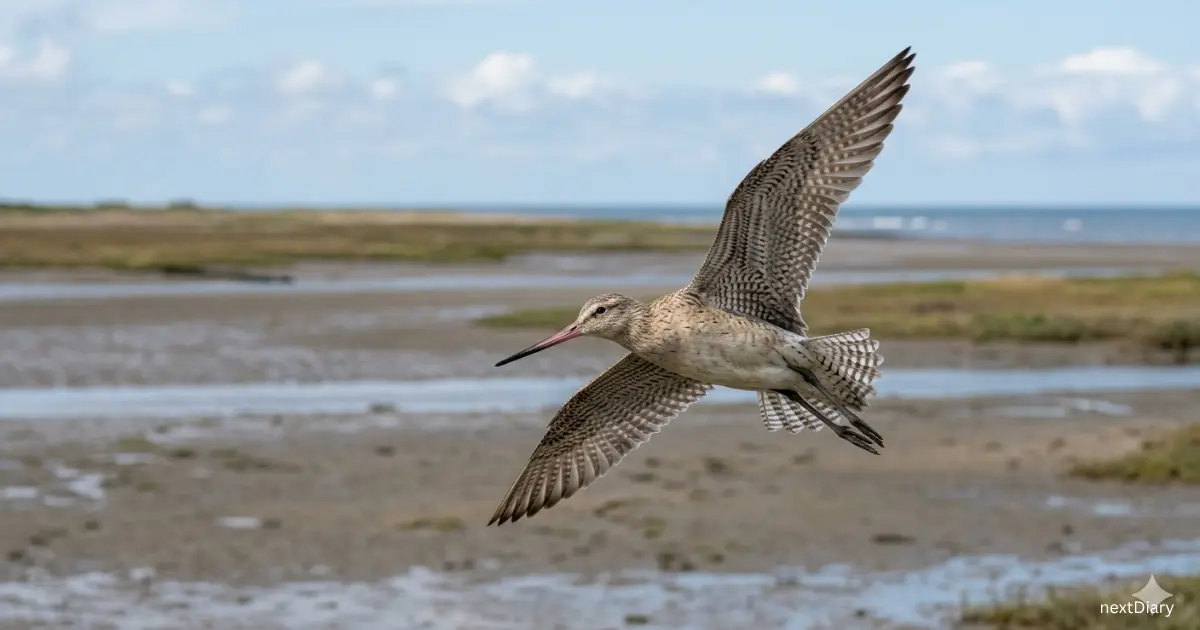

The juvenile bar-tailed godwit that flew from Alaska to Tasmania in 11 days did more than break a record. Its journey traced a migratory system that depends on shrinking wetlands, stable winds and international cooperation that is still falling short.
On 24 October 2022, a five-month-old bar-tailed godwit dropped into Ansons Bay in north-east Tasmania after 11 days and one hour in the air. It had left Alaska on 13 October, crossed the Pacific without landing, and covered 8,425 miles (13,560km) on a single tank of fat. The bird, known to researchers as B6, was a juvenile on its first southbound migration. That alone would have been remarkable. The fact that it set a world record for the longest documented non-stop flight by a bird makes it something else entirely: a small, cinnamon-brown shorebird carrying the full absurdity of migration on its back.
B6 was fitted with a 5g solar-powered satellite transmitter on the Seward Peninsula near Nome by researchers from the U.S. Geological Survey, the Max Planck Institute and the U.S. Fish and Wildlife Service. By the time it reached Tasmania, the tag had mapped one of the most extraordinary movements in the natural world.
The headlines wrote themselves. But the more interesting story lies beneath the feat itself. How does a bird weighing little more than a cricket ball cross an ocean without food, water or sleep in any normal sense of the word? And what does it mean to celebrate a migration record when the chain of habitats that makes such journeys possible is under growing pressure?
Built for the long haul
Bar-tailed godwits are not simply tough birds. They are anatomically remodelled for endurance.
Before departure, Alaska-breeding godwits of the subspecies Limosa lapponica baueri feed intensively at staging areas such as the Kuskokwim Delta and Kuskokwim Shoals. In the final run-up to migration, fat can account for more than half their body mass. The rest of the body changes too. In a 1998 paper with the disarmingly blunt title Guts Don’t Fly, Theunis Piersma of the Royal Netherlands Institute for Sea Research and Robert Gill of the USGS showed that bar-tailed godwits about to leave on trans-Pacific flights had drastically reduced digestive organs. Put crudely, they strip out machinery they will not need in mid-air and replace it with fuel.
That is not metaphor. It is engineering.
“Godwits are extreme athletes, but they are also extreme opportunists,” Robert Gill Jr, an emeritus wildlife biologist at the USGS Alaska Science Center and one of the leading figures in godwit migration research, said when earlier work on the species’ Pacific crossings was published. “They select conditions that give them the best possible chance of success.” Gill has spent decades following these birds across the Pacific and helped establish just how far their so-called non-stop flights really go.
A 2009 paper in Proceedings of the Royal Society B tracked Alaska-breeding godwits flying 8,117 to 11,680km non-stop across the Pacific to New Zealand and eastern Australia. At the time, those flights redrew the upper limits of avian endurance. B6, a decade later, went further still.
The route is not random. In a 2014 study in Animal Behaviour, Gill and colleagues found that bar-tailed godwits appear to choose departure windows that align with favourable winds not just at take-off but across the broader Pacific. In other words, they do not merely wait for a tailwind over Alaska. They seem to time departures around linked weather systems stretching thousands of miles ahead.
That finding carries a certain dry astonishment. Airline pilots pore over weather charts before long-haul flights. Godwits, apparently, do something not wholly dissimilar, albeit without the charts.
The first journey may be the hardest
B6’s age matters.
Adult bar-tailed godwits migrate every year between Alaska and non-breeding grounds in New Zealand and Australia. Juveniles are another matter. Scientists knew young birds must make the trip somehow, but until recently they had not tracked a hatch-year godwit through its first southbound migration. B6 showed that a bird only a few months out of the egg can navigate across the Pacific with startling precision.
That is both thrilling and faintly unnerving. There are no practice runs for this kind of migration. No older bird leads the way. A juvenile launches south over open ocean and either reaches land or does not.
Daniel Ruthrauff, a research wildlife biologist at the USGS Alaska Science Center and part of the team studying juvenile godwits in Alaska, has described the work as an attempt to understand how young birds survive this first migratory gauntlet and where, in the course of a year, they face the greatest risks. Those risks are not evenly distributed. Some are concentrated on the breeding grounds in Alaska. Others sit thousands of miles away at estuaries and mudflats most readers will never have heard of.
That is the awkward truth about migration stories. The bird is charismatic; the bottlenecks are often not.
A record written in mud
For all the attention lavished on B6’s Pacific crossing, the fate of bar-tailed godwits may hinge less on their ability to cross oceans than on the quality of a handful of coastal stopovers.
The Alaska-breeding baueri population spends the northern winter in New Zealand and south-east Australia, but on northward migration it depends heavily on the Yellow Sea, especially staging sites around the Chinese and Korean coasts. BirdLife International describes the north Yellow Sea as a crucial stopover area for almost the entire baueri population during spring migration. The birds pause there to refuel before the final leg to Alaska.
Take that staging network apart and the whole migration begins to fail.
This is not hypothetical. Across the East Asian–Australasian Flyway, intertidal mudflats have been reclaimed, industrialised, disturbed and in places simply erased. A 2022 study in Frontiers in Marine Science found that total abundance of 45 shorebird species in the Yellow River Delta declined by more than 90 per cent between 1995 and 2020, with bar-tailed godwit among the species showing marked decreases. The causes are familiar enough by now: coastal reclamation, habitat degradation, changing sediment flows and pressure on the invertebrate prey these birds need to rebuild their fuel reserves.
BirdLife’s 2025 review of migratory shorebirds offered a broader warning. Using flyway-scale monitoring data, it found that 34 per cent of migratory shorebird species are now of global conservation concern, after a run of Red List uplistings driven by sustained declines. Migration, for all its elegance, creates a dependence on a very thin chain of suitable habitat. Break one link and the cost is paid elsewhere.
The bar-tailed godwit is not currently among the most imperilled of shorebirds. But it is increasingly treated as a barometer of something larger: the health of the East Asian–Australasian Flyway itself.
Why policy matters to a bird over the Pacific
The odd thing about a bird flying alone over open ocean is that its survival depends so heavily on meetings held in conference centres.
Conservation of migratory shorebirds along the East Asian–Australasian Flyway is spread across a patchwork of mechanisms. There is the Convention on the Conservation of Migratory Species of Wild Animals, better known as CMS. There is the East Asian–Australasian Flyway Partnership, which tries to coordinate action across 22 countries and the migratory routes that connect them. In the United States, the Migratory Bird Treaty Act provides a legal backdrop for bird protection. In Australia and New Zealand, site-level protections matter enormously, because that is where exhausted birds finish their journeys.
The problem is not a complete absence of frameworks. It is that frameworks are easier to announce than mudflats are to restore.
Flyway conservation requires countries to protect breeding habitat in Alaska, staging sites in the Yellow Sea and non-breeding estuaries in Australasia at the same time. It also requires governments to think beyond the reserve boundary. Shorebirds are vulnerable to coastal squeeze, pollution, hunting pressure in parts of their range, human disturbance and the less visible distortions of climate change, including altered storm tracks and sea-level rise.
That last threat is worth dwelling on. Godwits appear exquisitely tuned to atmospheric conditions. Their migrations depend on wind profitability, to use the language of the science. A tailwind can turn an impossible journey into a merely astonishing one. Change those wind regimes, or the timing of storms across the Pacific, and the arithmetic of migration shifts with them.
The 2014 Animal Behaviour paper hinted at the stakes. Godwits are flexible, but not infinitely so. Researchers documented birds making abrupt course changes in response to severe weather. One bird expended so much energy coping with headwinds that it failed to breed that season.
For a species that lives on margins of timing and fuel, a bad weather decision is not a small inconvenience. It can cancel a year.
What B6 tells us, and what it does not
It is tempting to treat B6 as a feel-good conservation story: a young bird does something impossible, scientists track it, the public marvels. There is truth in that. The journey was extraordinary, and wonder still matters. Conservation without wonder quickly turns into bookkeeping.
But there is a risk in mistaking resilience for safety.
A bar-tailed godwit can cross the Pacific without landing. It can shrink its guts, bulk its flight muscles and burn through extraordinary reserves of fat. It can, apparently, read the weather better than many of us manage with a smartphone. None of that protects the species if the places it needs before and after the flight disappear.
That is the contradiction sitting inside B6’s record. The bird’s flight looks like invincibility. In ecological terms, it may be closer to exposure. The longer and more specialised the migration, the less room there is for failure in the system around it.
When B6 reached Tasmania in October 2022, it was not simply ending a journey. It was touching down at the far end of an international conservation problem that begins in Alaska, narrows through the Yellow Sea and depends on decisions taken by governments that may never have a bar-tailed godwit in view.
The record will stand until another bird breaks it. The more pressing question is whether the flyway beneath it will hold long enough for that to happen.