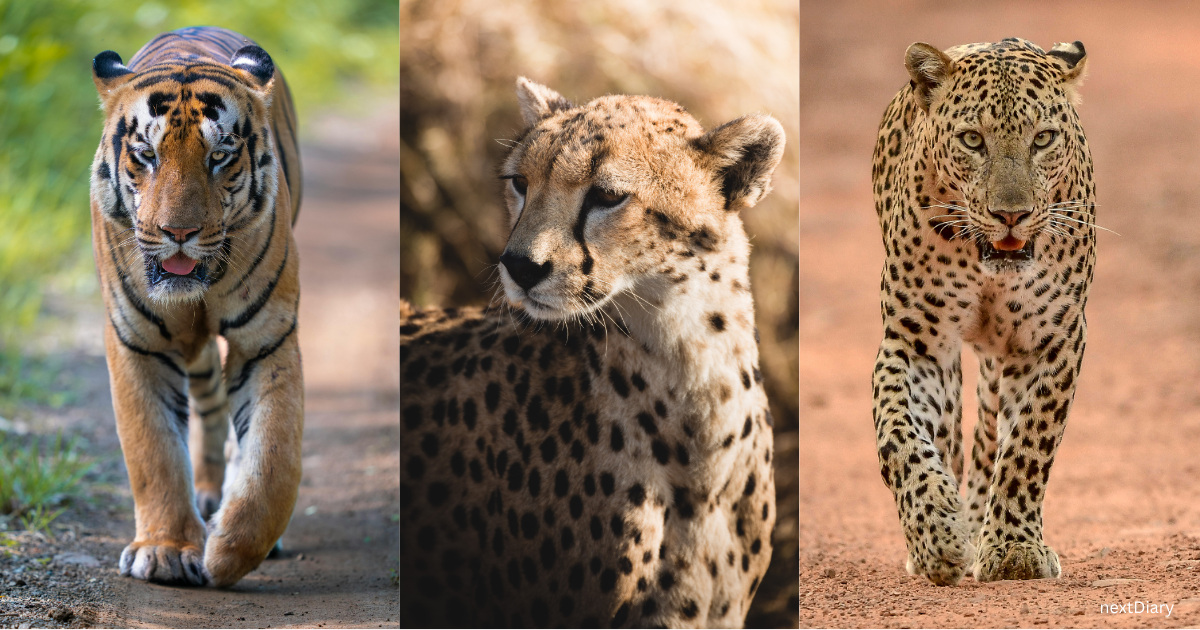

When a cheetah from Kuno turned up in tiger country, the photographs looked extraordinary. The harder question is what the encounter says about India’s crowded carnivore landscapes, and whether Project Cheetah is ready for them.
On the banks of the Chakal river in Rajasthan’s Ranthambore Tiger Reserve, safari vehicles had already clocked the tiger when word spread that a leopard was on the move too. Then came the third cat. Not another tiger, but KP-2, a young male cheetah that had wandered in from Kuno National Park in neighbouring Madhya Pradesh. Three big predators, all recorded in Zone 9 within roughly one to two kilometres of each other on 20 April, in a reserve better known for striped royalty than speed.
It was the sort of sighting that instantly escapes the forest and enters the internet, stripped of context and inflated by astonishment. Rajasthan’s forest department called it “rare” and “unscripted”. That much is true. But the real significance of Ranthambore’s three-cat moment lies elsewhere.
This was not a tableau of harmonious coexistence. The tiger, leopard and cheetah were not lounging together for the benefit of tourists. Rather, a dispersing cheetah from India’s reintroduction programme had moved into a landscape dominated by two resident carnivores, one of them a tiger reserve with around 70 tigers and a substantial leopard population. That makes the episode less a wildlife curiosity than a stress test for India’s conservation planning.
A cheetah in tiger country
KP-2 is not a Ranthambore animal. He is a product of Project Cheetah, the government’s attempt to restore cheetahs to India more than 70 years after the species was declared extinct in the country. The project, overseen by the National Tiger Conservation Authority, began with the arrival of African cheetahs from Namibia in 2022 and South Africa in 2023, followed by a further import from Botswana this year. Its stated aim is to establish a free-ranging metapopulation of cheetahs across suitable grassland and scrub landscapes, starting with Kuno.
KP-2 had other ideas. According to forest officials, he crossed from Kuno into Rajasthan last week and then pushed deeper, eventually reaching Ranthambore’s tourism zone. That is striking in itself. Cheetahs are built for open and semi-open country, for seeing prey and being seen by it, not for weaving through a reserve where tigers still set the terms of engagement. “Such proximity among three large carnivores with distinct territorial and hunting strategies is extremely rare,” Rajkumar Chauhan, a wildlife expert quoted by PTI, observed after the sighting. He pointed to niche partitioning: the ecological habit of species carving up space, time and prey in order to avoid direct competition.
Tigers, in simple terms, tend to dominate. Leopards respond by becoming furtive, shifting into denser ground and often becoming more nocturnal. Cheetahs, by contrast, generally avoid exactly this sort of company if they can help it. In African systems, where cheetahs live alongside lions, leopards and hyenas, that often means using more open habitat and accepting that stealth and brute force are not part of the job description.
So what was KP-2 doing in Ranthambore? One answer is the simplest. He was dispersing, exactly as a young male carnivore is supposed to do.
Why dispersal matters
India’s cheetah programme has always depended on movement. The 2022 Action Plan does not envisage Kuno as a fenced showpiece stocked with a fixed number of animals. It imagines a broader cheetah landscape, with animals spreading between sites and, in time, between states. The latest planning documents identify a wider Kuno-Gandhi Sagar landscape, extending into parts of Rajasthan, as the nucleus of that ambition.
In that sense, KP-2’s walkabout is not a failure of the project. It is, awkwardly enough, part of the point.
The complication is that landscapes are not just lines on a planning map. Between Kuno and Ranthambore lie villages, roads, farmland, livestock and the politics of two state forest departments. KP-2 reportedly spent 55 days in Rajasthan before being tranquillised and returned to Kuno after preying on goats and cattle in Baran and Kota districts. That detail matters more than the viral photographs. Dispersal is only good news if the route is survivable, socially tolerable and ecologically sensible.
“There are signs of connectivity, yes, but also of pressure,” says Aditya Ghorpade, a conservationist quoted by The Indian Express, who argued that the Ranthambore overlap may say as much about shrinking habitat and crowding as it does about ecological resilience. That is not quite the same as saying the system is failing. It is a reminder that movement can signal opportunity and constraint at the same time.
The corridor question
Ranthambore and Kuno do not sit in isolation. They form part of a broader western Indian landscape threaded by ravines, reserve forests and riverine strips that tigers have used for years. WWF-India describes this western Indian tiger landscape as roughly 30,000 sq km of connected habitat stretching across Rajasthan and Madhya Pradesh, with Ranthambore acting as a source population for dispersing tigers. A young Ranthambore male was recorded in Kuno earlier this year. Now a Kuno cheetah has made the journey in the opposite direction.
From one angle, that is encouraging. Conservationists spend a great deal of time worrying about severed corridors, pinched by highways, mines and piecemeal development. A large carnivore moving between protected areas is evidence that some connective tissue remains.
From another angle, it exposes how uneven India’s carnivore policy has become. Tigers enjoy a mature national framework under Project Tiger, complete with designated reserves, funding lines and a political constituency most conservation programmes would envy. Cheetahs are still, in effect, on probation. The Supreme Court permitted the introduction of African cheetahs in 2020 on an experimental basis, and the project has been learning in public ever since.
That learning curve has not been gentle. Kuno has produced encouraging breeding results, but also a string of deaths, veterinary controversies and persistent questions about prey, heat stress and carrying capacity. The reserve was never meant to hold the entire burden of India’s cheetah return. Yet the second home long promised for the species, Gandhi Sagar Wildlife Sanctuary, remains a work in progress. Until additional sites are properly ready, dispersing males will continue to test the edges of the map for themselves.
More than a photo opportunity
There is another reason not to romanticise the Ranthambore sighting. Carnivore overlap is not inherently benign. Tigers kill leopards with some regularity. Leopards can take cheetah cubs. Adult cheetahs are hardly helpless, but they are not built to win close-quarter disputes with a tiger in thick cover. The fact that KP-2 passed through Ranthambore without obvious incident does not tell us very much about what repeated encounters would look like over time.
It does, however, tell us something about management. Officials from Ranthambore and Kuno quickly set up a joint monitoring camp and tracked the cheetah around the clock. That is sensible, and it will need to become routine rather than exceptional. A metapopulation spread across multiple-use landscapes requires more than satellite collars and emergency darting teams. It needs agreed interstate protocols, rapid compensation for livestock losses, a clear threshold for intervention, and habitats beyond Kuno that are genuinely ready to absorb dispersers.
Project Cheetah has often been sold to the public in grand language: the return of a lost species, the repair of a broken ecological role, the restoration of India’s grasslands and scrublands by giving them a charismatic flagship. All of that may still be possible. But Ranthambore’s three-cat cameo suggests the next phase will be less about ceremonial releases and more about administrative stamina.
A cheetah has walked into tiger country. The question now is whether India’s conservation system can keep up with the animal it has put back on the map.