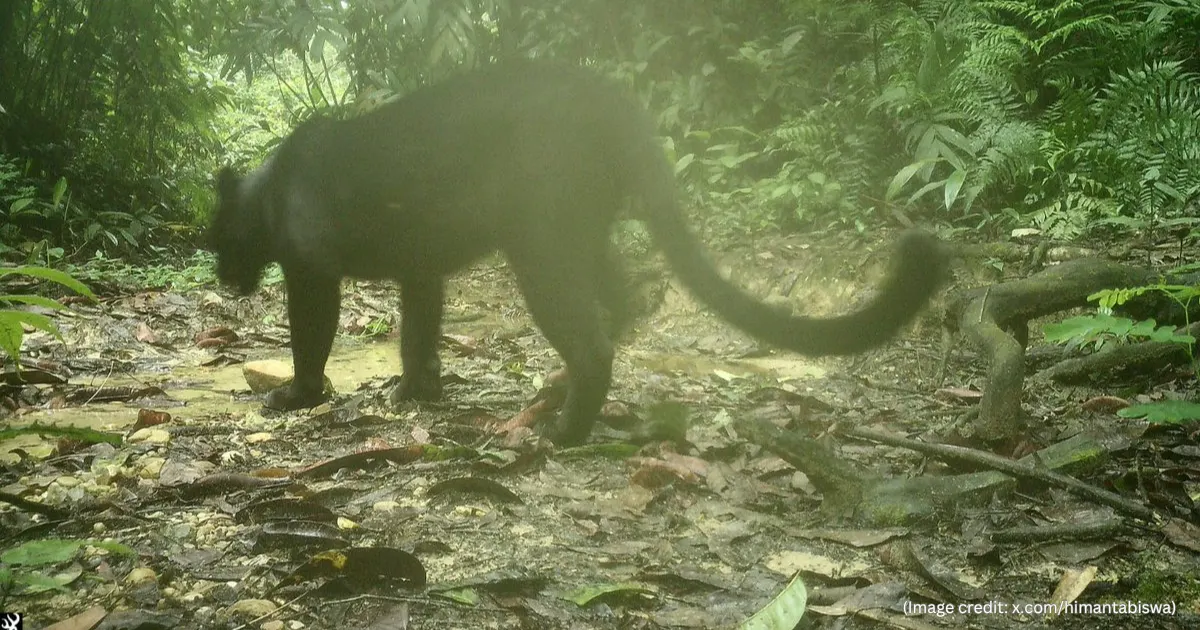

The first camera-trap image of a melanistic leopard in Assam’s Dulung Reserve Forest is more than a wildlife curiosity. It is a test of whether a rare sighting can translate into lasting protection for a pressured landscape.
On 15 June, a black leopard stepped through the understorey of Dulung Reserve Forest in Assam’s Lakhimpur district and into the public imagination. The animal, photographed by a camera trap and announced by chief minister Himanta Biswa Sarma, was the first documented sighting of a melanistic leopard, often called a black panther, in the reserve. For a few hours, social media did what it always does with a dark, handsome cat. It marvelled. Then it moved on. The harder question is whether the forest beneath that cat’s paws will receive the same attention.
Dulung, or Dullung in official records, is not one of Assam’s headline reserves. It lacks the international cachet of Kaziranga or Manas. Yet its roughly 9,900 hectares sit in a biologically busy district of tropical rainforest and floodplain forest, where elephants, primates, birds and a long list of lesser-known species still persist.
That matters because melanistic leopards do not appear by magic. They are ordinary Indian leopards, Panthera pardus fusca, carrying a genetic mutation that darkens the coat. Their presence tells us little about romance and rather more about cover, prey and the ability of a predator to move through a forest without being seen.
What exactly was seen in Dulung?
The photographs released by the Assam government show a dark-coated leopard passing a camera trap in Dulung Reserve Forest, in the Kadam subdivision of Lakhimpur. In a post on X, Cheif Minister of Assam Mr Himanta Biswa Sarma called it “a rare and remarkable sighting for Assam’s wildlife” and said the animal’s presence reflected “the ecological significance of our reserve forests”.
That is the official framing, and it is not wrong. Large carnivores sit high in the food web. If a leopard, melanistic or otherwise, is using a forest, the place must still be offering some combination of prey, cover and relative quiet.
But “first sighting” needs careful handling. It means the first documented camera-trap record from Dulung, not necessarily the first time such an animal has ever padded through the reserve. Forests reveal only what the cameras happen to catch. For elusive cats, absence of evidence is rarely evidence of absence.
Why do black leopards appear in some forests?
A black panther is not a separate species. In India, the term usually refers to a melanistic leopard: an Indian leopard carrying a mutation that causes an overproduction of dark pigment, melanin. The rosettes do not disappear. In the right light, they can still be seen, ghosting beneath the black coat.
Scientists are still refining the details, but the broad picture is clear enough. A 2025 paper in BMC Genomics, led by Avijit Ghosh of Amity University and colleagues including researchers from the National Centre for Biological Sciences and the Zoological Survey of India, identified a mutation in the ASIP gene in an Indian melanistic leopard. The study adds molecular detail to something field biologists have suspected for years: melanism in leopards is a genuine inherited trait, not some zoological parlour trick.
More interesting, perhaps, is where black leopards tend to turn up. Research on leopard populations in India and south-east Asia suggests melanism occurs more often in tropical and subtropical moist forests than in open country. Dense forest, with its low light and heavy cover, may favour darker animals, or at least not penalise them. In practical terms, a black leopard in a closed-canopy forest has a useful habit of becoming almost invisible by the time your eyes have found where it was.
Dulung’s significance lies in the habitat, not the headline
Dulung Reserve Forest sits within the Lakhimpur Forest Division, a landscape bounded to the north by the Himalayan foothills and to the south by the Brahmaputra plains. Official district records list it among five reserved forests in the division. The forests here are not pristine museum pieces. They are working landscapes, shaped by erosion, encroachment, roads, village use and the constant negotiation between conservation and livelihood.
That is why the panther matters.
Last August, the inaugural Dulung butterfly walk recorded more than 70 butterfly species in a single outing, alongside moths and birds. Loren Sonowal of the Nature Conservation Society, who co-led the event, described the tally as evidence of the forest’s “incredible biodiversity”. Madhab Das, another organiser, stressed the value of such surveys in creating local awareness about why these habitats need protecting.
Butterflies are not leopards, obviously. But the principle is the same. Biodiversity surveys, camera-trap images and species lists are all fragments of the same argument: that Dulung is not empty green on a map, but a functioning ecological system with enough complexity to support predators, pollinators and everything in between.
A reserve forest is protected, but not invulnerable
There is a policy wrinkle here that tends to get lost once the photographs start circulating.
Dulung is a reserved forest, a legal category created under the Indian Forest Act of 1927. That status matters. It gives the state significant powers to regulate use and protect forest land. But a reserved forest is not the same as a national park or tiger reserve, with their tighter restrictions and often greater visibility. Protection on paper is only the beginning. What counts is enforcement, funding, staffing and the political will to resist the slow grind of degradation.
The Lakhimpur Forest Division’s own records point to familiar pressures: flood damage, erosion, encroachment and the ongoing work of reclamation and restoration. The division has also been implementing afforestation and forest restoration under schemes including CAMPA, the Compensatory Afforestation Fund Management and Planning Authority, and the Assam Project on Forest and Biodiversity Conservation.
Those initiatives matter, though they are not cure-alls. Planting trees is easier than rebuilding an intact forest. And an apex predator does not care much for a spreadsheet showing hectares planted if the understory has been simplified, the prey base diminished or the corridor severed by disturbance.
Camera traps are useful. They are not a conservation strategy
There is another risk in stories like this. Camera traps can create the illusion of certainty.
One handsome image can suggest a thriving population where there may only be a single transient individual. It can also encourage a lazy narrative of success, as if the appearance of one rare animal automatically validates every conservation policy in the vicinity.
It does not.
What the Dulung image should trigger now is more work. Repeated camera-trap surveys, prey assessments, habitat mapping and, ideally, genetic sampling from scat or hair if that becomes feasible. Forest managers will want to know whether this was a lone animal moving through, part of a local breeding population, or a sign of wider leopard use across the reserve and adjoining forests.
There is also the question of connectivity. Leopards are mobile animals, and north-east India’s forests function best when they remain linked. If melanistic leopards are appearing more often in Assam and neighbouring landscapes, scientists will want to know whether that reflects better monitoring, healthy movement between forest blocks, or something less encouraging, such as smaller, more isolated gene pools.
What happens next?
For now, the black leopard of Dulung is one image and several unanswered questions.
It has, at the very least, done what charismatic wildlife occasionally does best: force attention onto a place that might otherwise remain peripheral. Dulung Reserve Forest now has a fleeting moment in the national spotlight. The danger is that it stays fleeting.
A melanistic leopard can carry a great deal of symbolism. It can also carry an unreasonable burden. No single cat, however photogenic, can prove that a forest is secure. It can only suggest that something valuable still survives there.
The real test comes after the headlines. Will Dulung receive the patient, unglamorous investment that conservation usually requires: more monitoring, stronger protection against encroachment, support for local communities, and the political patience to treat a reserve forest as more than spare land with trees on it?
The black panther has already slipped back into the forest. The rest of us are left to decide whether we were looking at an ending, or a warning not to squander the beginning.