
New species from Milne Bay reveals how much of the Indo-Pacific reef world remains undocumented
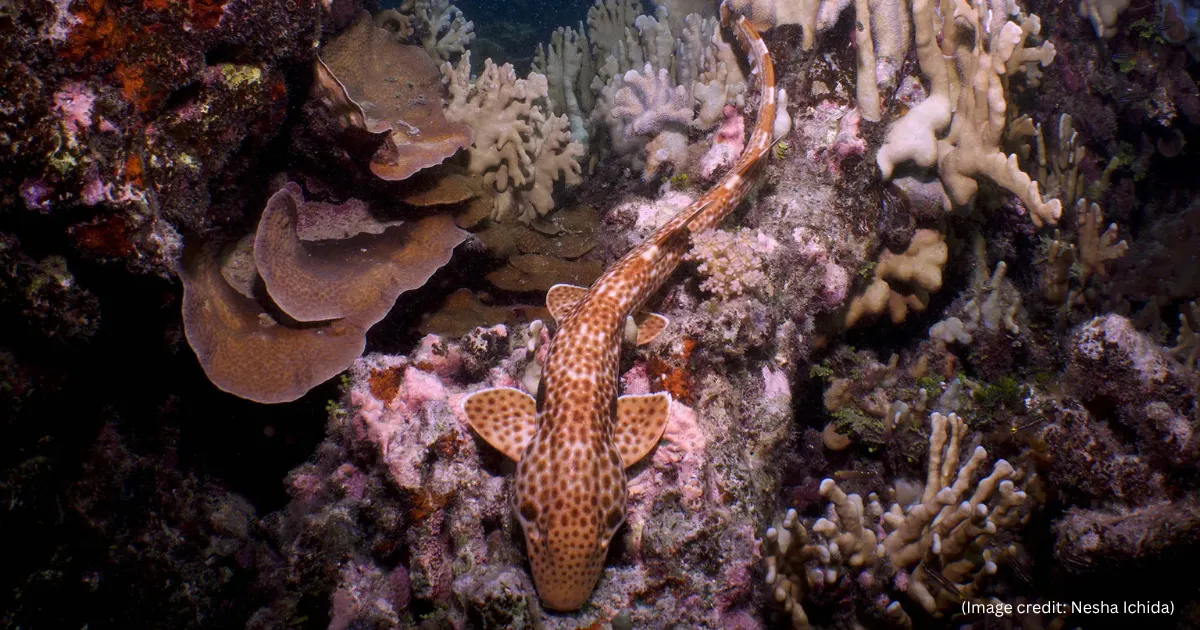
On a humid night off the coast of Milne Bay Province, Papua New Guinea, a dive torch cuts through black water and lands on a slow-moving shape no longer than a child’s arm. It does not swim away. Instead, it “walks” across the seabed on flexible fins, pausing between coral heads as if choosing its path carefully, while the reef crackles quietly around it in the dark.
The animal, later confirmed as a previously undescribed walking shark, belongs to the genus Hemiscyllium, a group already famous among marine biologists for their ability to use pectoral fins to “walk” across shallow reefs. But this individual, recorded in the waters of Milne Bay, turned out to represent something more significant than an unusual encounter. It was a species new to science.
Marine researchers say the discovery underscores a deeper truth about the Coral Triangle, the global epicentre of reef biodiversity. Large parts of it remain poorly surveyed, even as fishing pressure, warming seas and coastal development intensify.
A chance encounter in Milne Bay
The first encounter did not happen in a laboratory or on a research vessel’s sonar screen, but during a night dive along a reef slope near the Trobriand Islands.
According to field notes shared by marine biologist Mark Erdmann, a senior adviser with Conservation International who has spent decades working in Papua New Guinea and Indonesia, the shark was initially assumed to be a known walking shark species.
“At first glance it looked familiar,” Erdmann says. “But the colour pattern, the proportions, the way it moved across the reef flat at night. It didn’t quite match anything we had documented before.”
Erdmann, who helped describe several other walking shark species across the region, recalls the moment with professional understatement. “You learn to be cautious with excitement in taxonomy,” he says. “But we knew we were looking at something that needed a closer look.”
That closer look involved genetic sampling and morphological comparisons with museum specimens across Australia and Indonesia. The results, later published in a peer-reviewed taxonomy journal, confirmed the suspicion. This was a distinct species within a lineage already known for rapid regional diversification.
What makes a shark walk
Walking sharks, all within the genus Hemiscyllium, are not walking in the terrestrial sense. Instead, they use strong, paddle-like pectoral and pelvic fins to push along the seabed in shallow water.
It is an energy-efficient adaptation for life in tidal reef flats, where oxygen levels, water depth and coral complexity change dramatically over short distances.
Helen Sykes, a marine conservation consultant who has worked on reef monitoring programmes in Papua New Guinea for more than 20 years, says the behaviour is only part of the story.
“These sharks are incredibly specialised,” she says. “They are tied to very specific reef habitats. That makes them fascinating scientifically, but also vulnerable. If you damage that reef, you are not just losing habitat. You are potentially losing an entire species.”
Walking sharks are also nocturnal hunters, feeding on small invertebrates and fish hidden among coral rubble. Their cryptic lifestyle means they are rarely seen, even in areas where they are relatively common.
Why new sharks are still being found
The discovery of a new shark species in 2026 might sound surprising, but scientists say it reflects how little of the Indo-Pacific reef system has been properly surveyed.
Christine Dudgeon, a marine biologist at the University of Queensland who has studied walking sharks and their evolution, says the genus is still revealing its diversity.
“We are seeing a pattern of very fine-scale endemism,” she explains. “Populations that look similar at first glance are genetically distinct once you analyse them. In some cases, they may have been separated for hundreds of thousands of years.”
That evolutionary fragmentation is driven by geography. The reefs of Papua New Guinea are split by deep channels, shifting currents and isolated island chains. Over time, these barriers can create genetically distinct populations that eventually become separate species.
Dudgeon says the implication is clear. “We are not dealing with one widespread walking shark species. We are dealing with a complex of species, many of which are restricted to very small ranges.”
A fragile reef frontier
Milne Bay sits within the Coral Triangle, a marine region that spans six countries and contains more than 75 per cent of known coral species. It is often described as the “Amazon of the seas”, but it is also under increasing pressure.
Local fisheries provide protein and income for coastal communities, but reef fish stocks have declined in many areas due to overfishing and destructive practices. Climate change adds another layer of stress, with coral bleaching events becoming more frequent.
Papua New Guinea has committed to expanding marine protected areas under its national biodiversity strategy and is a signatory to the Convention on Biological Diversity, which sets global targets for ecosystem protection. But enforcement remains uneven, particularly in remote provinces.
Sykes says that gap between policy and practice is critical. “On paper, there is protection. On the water, it depends on capacity, funding and local governance. That is where conservation succeeds or fails.”
What protection does a newly named species receive
In theory, newly described species can be considered for protection under frameworks such as the Convention on International Trade in Endangered Species of Wild Fauna and Flora (CITES), which regulates international trade in wildlife.
In practice, listing takes time, and data requirements are high. For many newly discovered marine species, population size, distribution and threat levels are still poorly understood at the moment of description.
Mark Erdmann says that delay is one of the central challenges in marine conservation. “By the time we have enough data to formally assess extinction risk, the pressures on the habitat have often already increased.”
For walking sharks, there is no targeted international trade at scale, but they are caught incidentally in small-scale fisheries and can be affected by reef degradation and habitat loss.
What happens next
The discovery of Hemiscyllium dudgeonae adds another piece to a rapidly evolving puzzle of reef biodiversity in the Indo-Pacific. But it also raises uncomfortable questions about how many species remain unknown, and how quickly they may disappear once they are found.
Erdmann puts it more bluntly. “We are still describing life on Earth at the same time as we are changing it.”
Back in Milne Bay, surveys continue. Night dives still sweep across reef flats, and torch beams still catch movement in the sand and coral rubble. Each pass holds the possibility of another species waiting quietly in the dark.
Whether those discoveries arrive in time to inform protection, or only to document loss, remains an open question.