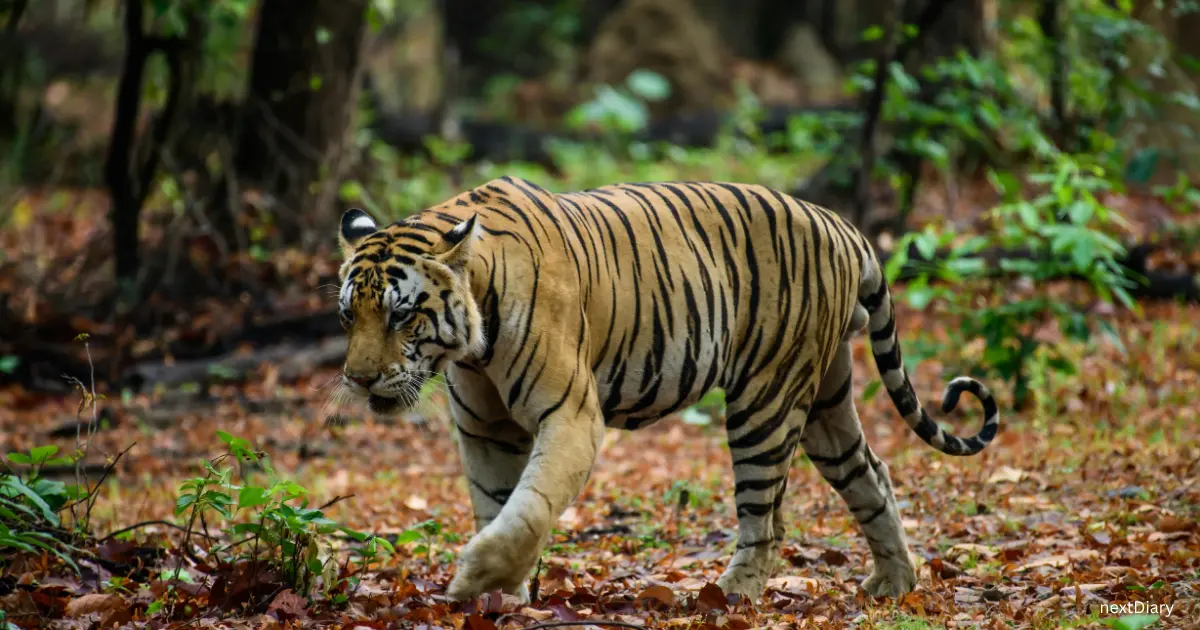

“India has 3,682 tigers and 891 lions. Its next challenge is living with them.” Big-cat numbers are rising, but the harder conservation work now lies beyond reserve boundaries
India’s recovery of tigers, lions, leopards and snow leopards is one of the most striking wildlife stories of the past two decades. The question now is whether policy can keep pace with cats that no longer fit neatly inside protected areas.
On a warm May morning in Gir, western India, forest staff and volunteers spread across scrub forest, dry riverbeds and mango orchards, trying to count lions that no longer keep to the map. By the time Gujarat’s latest estimation was complete, the state had arrived at a figure of 891 Asiatic lions. It is an arresting number for a subspecies that hovered on the edge of extinction a century ago. It is also a warning. India’s big cats are recovering, and many are now living beyond the places designed to contain them.
For conservationists, this is the sort of problem one would rather have than the alternative. India’s tiger population has risen to 3,682, according to the latest official estimate for 2022, up from 1,411 in 2006. Leopard numbers in surveyed habitats stand at 13,874. The country’s first national snow leopard assessment, released in 2024, put the total at 718.
Taken together, the figures amount to one of the most consequential recoveries of large carnivores anywhere in the world.
But conservation success has a habit of complicating itself. Cats disperse. Young males leave crowded reserves. Lions move into revenue land, coastal scrub and farmland. Leopards make a living in sugarcane, plantation edges and the ragged green seams around towns. Tigers turn up in corridors threaded by roads, railway lines and villages. What looks, from Delhi, like a triumph of policy can feel rather different in a village that has lost livestock, or where children are now walked to school in groups.
A recovery built on state power, patience and money
India’s tiger story is the best known, and for good reason. Project Tiger, launched in 1973, has had more than half a century to accumulate institutions, fieldcraft and political muscle. Today the National Tiger Conservation Authority oversees a network of 58 tiger reserves, and the formula is by now familiar: legal protection, anti-poaching patrols, habitat management, camera-trap monitoring and, where politically possible, the creation of inviolate core areas.
It has worked. A 2025 paper in Science, led by Yadvendradev Jhala of the Indian National Academy of Sciences, found that India had doubled its tiger population in a little over a decade, helped by secure protected areas, prey recovery and support for coexistence in surrounding landscapes. The paper also made a point worth lingering over: tiger recovery was not simply a function of drawing lines around forests. It depended on what happened outside them too.
“The success was built on rigorous monitoring, secure protected areas, and a culture of coexistence,” Jhala told Nature India when the study was published. That final phrase matters. It is doing a good deal of work.
India now holds roughly three quarters of the world’s wild tigers. That statistic is often deployed as a badge of honour, and not without justification. Yet it can obscure a more awkward truth. Tigers have recovered in a country where millions of people live in and around suitable habitat. Conservation here has never been a matter of fencing off wilderness and stepping away. It is an exercise in continuous negotiation.
The cats do not recognise the boundaries
That is perhaps most obvious in Gujarat, where the Asiatic lion has staged a recovery so remarkable that it has created its own political headache.
The 16th lion population estimation, carried out in May 2025, put the number of lions in Gujarat at 891, up from 674 in 2020. Researchers writing in Global Ecology and Conservation this year described not merely population growth but range expansion, with lions spreading across a broader Saurashtra landscape that includes protected areas, forest fragments, coastal habitats and human-used land.
This is, in one sense, splendid news. A larger lion population is a less fragile one. It is also an increasingly concentrated one. Almost the entire global population of Asiatic lions remains in and around a single state. For years, wildlife biologists have argued that this is a dangerous arrangement. A disease outbreak, extreme weather event or other ecological shock in one landscape could have consequences for the entire subspecies.
Ravi Chellam, conservation scientist and chief executive of Metastring Foundation, has long argued that a second free-ranging population is not a luxury but a necessity. The logic is plain enough. Conservation is not just about boosting numbers; it is about reducing risk. In lion terms, India has done the first job rather well and still has not finished the second.
That tension has a long policy tail. The Supreme Court directed in 2013 that some lions should be moved to Kuno in Madhya Pradesh. The translocation has not happened. In the meantime, Kuno has become the stage for India’s cheetah reintroduction project, while lions remain concentrated in Gujarat.
This is where the big-cat success story becomes less comfortable. Conservation in India is often excellent at emergency rescue and less agile when the solution requires cooperation across state borders, political compromise or the surrender of symbolic ownership.
Leopards, the adaptable neighbours nobody quite knows what to do with
If tigers represent the prestige end of Indian carnivore conservation, leopards are the untidy reality. They are adaptable, resilient and disconcertingly capable of living among us.
The official leopard estimate for 2022 put the population at 13,874 across surveyed tiger-range habitats, an increase on 2018. But the more revealing detail sits behind the headline. In some landscapes, especially the Shivalik hills and Gangetic plains, declines were recorded. Elsewhere, substantial numbers of leopards live outside protected areas altogether.
Vidya Athreya, an independent ecologist whose work has transformed understanding of leopards in western India, has spent years puncturing the myth that big cats can survive only in remote forests. Her research showed leopards persisting in densely populated agricultural landscapes, often feeding on feral dogs and livestock and moving largely at night to avoid people. It was a quietly radical finding. It suggested that coexistence was not a slogan but an ecological fact, albeit a precarious one.
The trouble is that coexistence can be used to mean two rather different things. It can describe a genuine accommodation, backed by compensation schemes, better livestock protection, rapid response teams and communities that receive some benefit from wildlife. Or it can become a polite way of saying that rural people are expected to absorb the costs of living with predators because the state has few alternatives.
Recent events in Maharashtra show how quickly the equation can sour. Leopard conflict in agricultural landscapes has led to intensive trapping operations and new plans for rescue centres. These may reduce immediate risk to people, but they also underline a broader failure to manage shared landscapes before they become crisis zones.
Snow leopards and the quieter frontier
Snow leopards sit apart from the rest of India’s big-cat story, not least because they inhabit a different country altogether, at least in ecological terms. Their world is high, cold and thinly peopled, stretching across Ladakh, Himachal Pradesh, Uttarakhand, Sikkim, Arunachal Pradesh and Jammu and Kashmir.
The first nationwide Snow Leopard Population Assessment in India, or SPAI, estimated 718 animals, with 477 in Ladakh alone. More than 70 per cent of the species’ potential range was covered. For a cat known as the ghost of the mountains, it was an unusually tangible portrait.
Yet here too, the good news is threaded with warning. More than half of India’s snow leopards occur outside protected areas. Their future depends on pastoral landscapes where livestock depredation, feral dogs, infrastructure and climate change all press on fragile mountain ecosystems.
Sambandam Sathyakumar of the Wildlife Institute of India, who has worked on snow leopard conservation for decades, described the survey as baseline data rather than a finish line. That distinction is important. Counting a species is not the same thing as securing it. The Himalaya is warming faster than the global average. Roads, military infrastructure, hydropower and tourism are pushing further into once remote terrain. The snow leopard may be elusive, but its habitat is not beyond reach.
Beyond fortress conservation
The hardest question hanging over India’s big-cat success is who bears the cost of it.
Protected areas remain essential. There is no serious conservation argument against secure breeding habitat for tigers, lions and other large carnivores. But the old fortress model, in which wildlife thrives only when people are removed or tightly excluded, looks increasingly incomplete. Tigers disperse through working landscapes. Lions are colonising land well outside Gir’s formal core. Leopards, in particular, have made a profession of ignoring our categories.
A paper in Nature Sustainability last year, reflecting on the Science tiger study, argued that both “land sparing” and “land sharing” were needed. In plain terms, that means strong protected areas and a willingness to invest in the places between them: corridors, compensation, prey recovery, community livelihoods, road mitigation and tolerance.
This is less romantic than tiger posters and lion census headlines. It is also more expensive, more political and harder to photograph.
The danger now is that India mistakes population growth for the end of the story. Big-cat conservation has entered a new phase, one in which the central question is no longer whether these animals can recover, but where they are expected to live once they do.
In that sense, the numbers from Gir, from the tiger reserves of central India and from the high Himalaya are not a conclusion. They are a test. India has proved that it can pull large carnivores back from the brink. It has not yet proved that it can build a future in which people who share land with them are asked to pay less of the bill.
And the cats, as ever, are already moving ahead of policy.