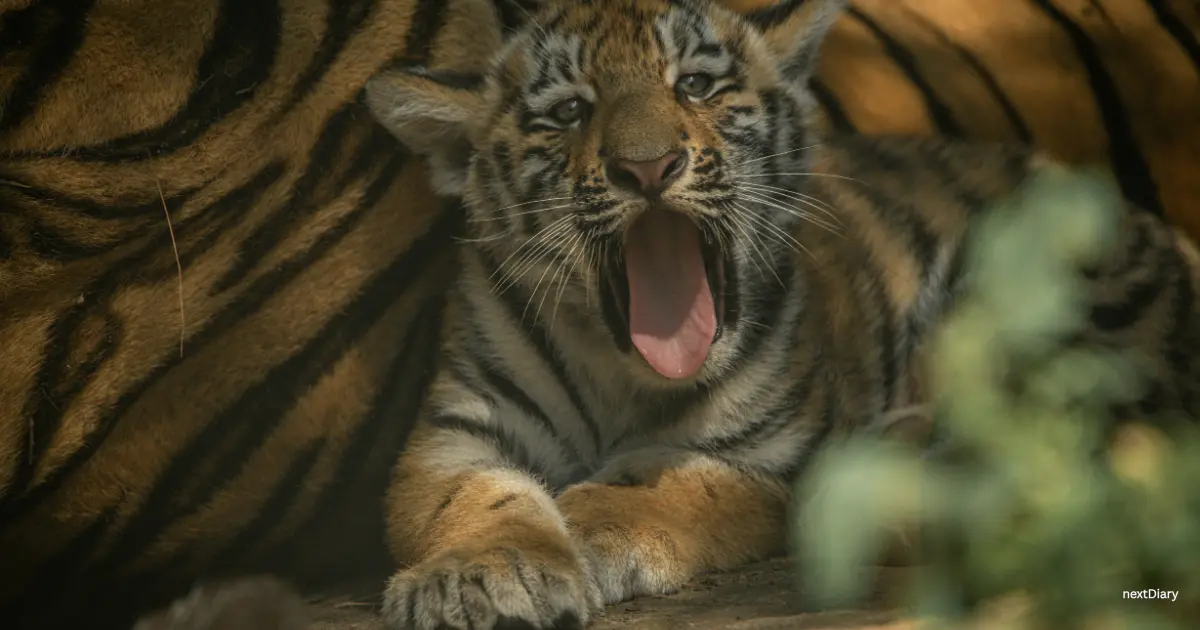

Once regarded mainly as a wildlife corridor, Kheoni Wildlife Sanctuary is now producing tiger cubs, raising fresh questions about how smaller protected areas can secure India’s conservation future.
On a warm June morning in Kheoni Wildlife Sanctuary, forest staff studying camera trap images found yet another family portrait. A tigress, moving carefully through teak and bamboo woodland, was followed by three healthy cubs. It was not an isolated sighting. It was further evidence that this modest reserve in Madhya Pradesh has crossed an important ecological threshold. Tigers are no longer simply passing through Kheoni. They are raising families there.
For decades, Kheoni occupied a quiet place on India’s conservation map. Covering about 130 square kilometres in Dewas and Sehore districts, it was valued primarily as a corridor linking larger forest landscapes. Young tigers dispersed through the sanctuary, but few stayed.
That picture has changed with surprising speed.
Officials now estimate that Kheoni supports around 10 adult tigers alongside multiple cubs from breeding females. For a sanctuary of its size, the figures represent a significant concentration of big cats and suggest that habitat quality has improved enough to support resident populations rather than transient animals.
From corridor to nursery
Tiger conservation has often focused on famous reserves such as Bandhavgarh, Kanha and Pench. Yet smaller protected landscapes frequently determine whether those larger populations remain genetically connected.
“Kheoni has emerged as a breeding habitat because ecological conditions have steadily improved,” says Subharanjan Sen, Principal Chief Conservator of Forests (Wildlife), Madhya Pradesh Forest Department. The combination of habitat protection, prey recovery and reduced disturbance has allowed females to establish territories and rear cubs successfully, he says.
That distinction matters.
A corridor simply enables animals to move between habitats. A breeding landscape provides everything needed to sustain future generations. The difference is measured not only in tiger numbers but in the survival of cubs over several years.
Camera traps have repeatedly photographed females with offspring, providing evidence that breeding has become established rather than incidental.
Restoring the landscape
The transformation did not happen by chance.
Forest officials, supported by state conservation programmes, strengthened anti-poaching patrols, restored degraded woodland and increased protection across the sanctuary. At the same time, prey populations including spotted deer, sambar and wild boar recovered under improved habitat management.
Without abundant prey, tiger conservation quickly reaches its limits. Adult tigers require large territories containing enough wild herbivores to sustain both themselves and growing cubs.
Conservationists also point to the relocation of several villages from the sanctuary’s core as a turning point. Voluntary relocation programmes remain controversial across India, but where communities receive fair compensation and long-term support, they can reduce habitat fragmentation while creating larger undisturbed areas for wildlife.
The approach aligns with India’s Project Tiger, launched in 1973 and now managed under the National Tiger Conservation Authority (NTCA), which promotes landscape-scale conservation rather than focusing solely on individual reserves.
Why breeding changes everything
A breeding population carries far greater conservation value than a collection of dispersing animals.
Yadvendradev Vikramsinh Jhala, senior tiger biologist at the Indian National Academy of Sciences, has long argued that India’s tiger recovery depends on maintaining connected landscapes rather than isolated strongholds. Young tigers regularly leave established reserves in search of territory, but they can only establish new populations if suitable habitat awaits them.
Kheoni appears to demonstrate precisely that process.
India’s most recent national tiger assessment estimated more than 3,100 wild tigers, accounting for roughly three-quarters of the global population. Those headline numbers attract attention, but conservation scientists increasingly focus on distribution rather than abundance alone.
A growing population squeezed into a handful of reserves creates new pressures, including territorial conflict, dispersal into agricultural landscapes and increased encounters with people.
Smaller breeding sites help ease that pressure.
The human dimension
Wildlife recovery rarely occurs without affecting nearby communities.
Farmers living around Kheoni have reported occasional livestock losses as tiger numbers increase. Forest officials have expanded compensation schemes while encouraging rapid reporting of incidents to reduce the risk of retaliatory killings.
Belinda Wright, Executive Director of the Wildlife Protection Society of India, has repeatedly argued that long-term tiger conservation depends as much on local trust as on ecological management. Communities that see prompt compensation and responsive governance are generally more willing to tolerate the presence of large carnivores.
That balance becomes increasingly important as India’s tiger population expands beyond the boundaries of well-known reserves.
For forest guards patrolling Kheoni, success also brings additional responsibility. Monitoring breeding females demands careful management of tourism, road access and human activity during sensitive periods when cubs remain vulnerable.
A wider lesson for conservation
Kheoni’s story reflects a broader shift in conservation thinking.
For years, success was measured largely by the number of animals living inside flagship protected areas. Increasingly, scientists assess the health of entire landscapes, examining how forests connect, how rivers function and whether wildlife can move safely between habitats.
The Convention on Biological Diversity’s Kunming-Montreal Global Biodiversity Framework, adopted in 2022, encourages countries to improve ecological connectivity alongside expanding protected areas. Kheoni illustrates what that principle looks like on the ground.
It also highlights the value of sustained investment. Habitat restoration seldom produces immediate results. Forest regeneration, prey recovery and breeding populations all develop over years rather than months.
The camera trap photographs now circulating from Kheoni are, in many ways, the visible outcome of decisions made more than a decade ago.
Whether this sanctuary continues its quiet transformation will depend on choices still to come. Protecting corridors beyond its boundaries, maintaining local support and resisting new pressures from development may ultimately prove harder than helping tigers return in the first place.
The cubs padding through Kheoni’s teak forests today represent more than a conservation milestone. They are also a reminder that the future of India’s tigers may increasingly rest not only in its famous reserves, but in smaller forests whose importance has only recently come into focus.