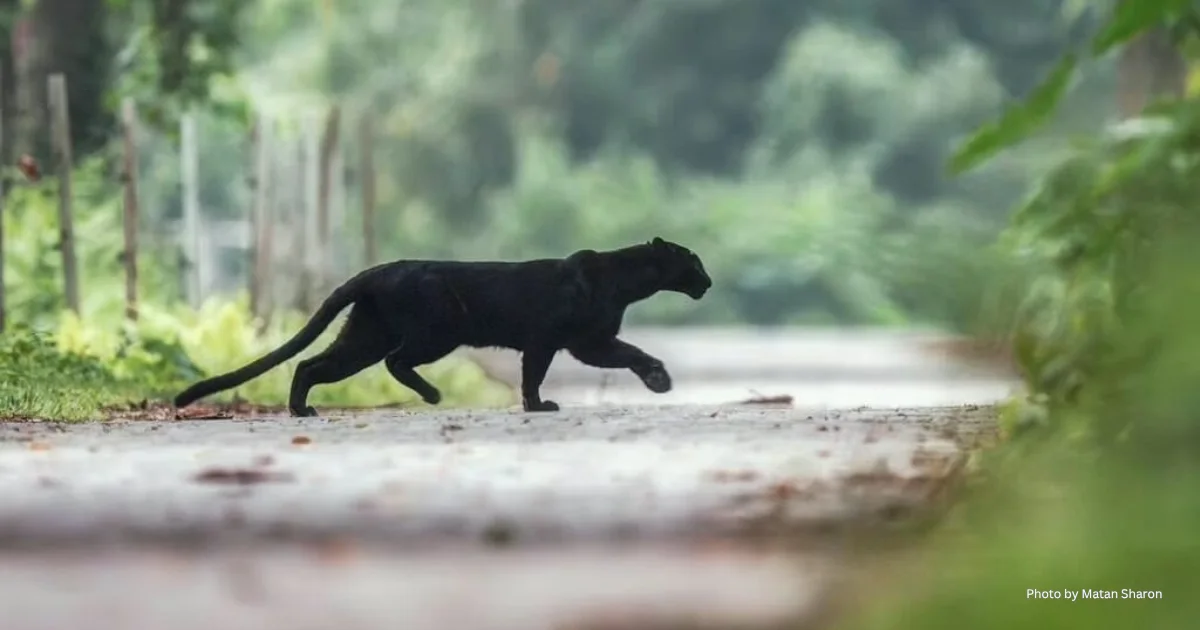

Rare photographs from north-east India reveal how a working tea plantation may offer an unexpected refuge for one of the world’s most elusive big cats.
In the early light of a tea plantation bordering Manas National Park in Assam, wildlife photographer Matan Sharon watched a black shape emerge from between orderly rows of tea bushes. It paused beneath a lone shade tree before two small cubs tumbled after it. For several weeks, Sharon documented something few people have ever witnessed: a melanistic leopard, commonly known as a black panther, successfully raising her young in a commercial plantation rather than deep inside the forest.
The images are remarkable for their rarity. Melanistic leopards occur because of a genetic mutation that produces an excess of dark pigment. They remain the same species as the familiar spotted leopard, although their rosettes are often still visible in bright sunlight.
Yet the photographs tell a story that extends beyond an unusually coloured cat. They offer a glimpse into how large carnivores are adapting to landscapes increasingly shared with people, and what that means for conservation in one of India’s richest wildlife regions.
Why a tea plantation?
To many observers, a tea estate appears an unlikely nursery for leopard cubs.
Rows of clipped bushes stretch across open ground, punctuated by scattered trees that provide shade for workers. But according to Sharon, those isolated trees became essential to the female’s survival strategy.
She repeatedly used them as escape routes whenever she sensed danger. Between hunting trips, she returned quickly to hidden den sites where the cubs remained concealed among dense vegetation.
“The plantation is actually safer than the forest in some respects,” Sharon explained after documenting the family. Larger predators, particularly tigers, present a significant threat to young leopard cubs inside protected forests. Avoiding those encounters may outweigh the risks associated with living close to people.
That trade-off is becoming increasingly familiar across parts of India.
Living alongside people
Leopards are among the world’s most adaptable large cats. Unlike tigers, they often tolerate fragmented habitats and regularly survive in agricultural landscapes, sugarcane fields and even on the edges of expanding towns.
Dr. Andrew Kitchener, Principal Curator of Vertebrates at the National Museums Scotland and a leading authority on wild cats, has previously noted that leopards succeed because they exploit habitats many other predators avoid. Their flexibility allows them to persist where forests have been altered, although it also increases encounters with people.
That adaptability carries risks.
India records hundreds of incidents involving leopards each year, ranging from livestock predation to animals wandering into villages. Most end without injury, but conflict remains one of the principal conservation challenges outside protected areas.
Tea plantations occupy a curious position within that landscape.
Unlike many forms of intensive agriculture, estates often retain mature shade trees, drainage channels and patches of scrub. Collectively, these features can function as wildlife corridors connecting larger forest blocks.
A globally important landscape
The plantation sits close to Manas National Park, one of India’s most celebrated protected areas and a UNESCO World Heritage Site.
The park supports Bengal tigers, Asian elephants, greater one-horned rhinoceroses, clouded leopards and the endangered golden langur. It also forms part of a transboundary landscape extending into Bhutan, allowing wildlife to move across international borders.
Dr. Bibhab Kumar Talukdar, Secretary General of the Aaranyak conservation organisation and Chair of the Asian Rhino Specialist Group at the International Union for Conservation of Nature (IUCN), has long argued that conserving wildlife in north-east India depends as much on the surrounding landscape as on protected areas themselves.
Animals do not recognise reserve boundaries. Their survival increasingly depends upon the condition of forests, plantations and community-managed land that lie between formally protected habitats.
More than a striking photograph
Photographs of black panthers often attract attention because melanistic leopards are exceptionally uncommon.
The dark coat results from a recessive genetic trait. In dense tropical forests, where filtered light creates deep shadows, some researchers believe the colouration may offer a modest hunting advantage, although the evolutionary reasons remain under investigation.
For conservationists, however, the colour is almost incidental.
What matters more is that the female successfully raised cubs in an environment shaped primarily for agriculture. Reproduction remains one of the clearest indicators that suitable habitat still exists.
Dr. Ullas Karanth, conservation biologist and Director Emeritus of the Centre for Wildlife Studies, has repeatedly emphasised that breeding populations, rather than isolated sightings, determine whether large carnivores are truly surviving in human-dominated landscapes.
Conservation beyond protected areas
India’s Wildlife (Protection) Act 1972 provides legal protection for leopards throughout the country.
That legislation, however, cannot by itself safeguard animals moving across private land.
Many tea estates in Assam already support elephants, civets, hornbills and smaller carnivores. Some have introduced wildlife-friendly management practices, including maintaining natural vegetation and limiting disturbance in sensitive areas.
Others remain vulnerable to expanding infrastructure, fencing and intensified land use.
Globally, the Convention on Biological Diversity, adopted in 1992, encourages countries to conserve biodiversity across entire landscapes rather than relying solely on isolated protected areas. The approach recognises that wildlife increasingly depends upon connected habitats where people live and work.
The black panther’s choice of nursery appears to reinforce that principle.
An uneasy coexistence
There is no guarantee the family will remain undisturbed.
Tea estates are busy workplaces. Harvesting, vehicles and expanding development all increase the possibility of disturbance. Cubs that survive their first months must still establish territories of their own, navigating roads, settlements and competing predators.
For Sharon, the experience was a reminder that extraordinary wildlife often survives unnoticed in ordinary places.
The plantation looked, at first glance, no different from countless others across Assam. Yet beneath its scattered shade trees, one of nature’s most elusive predators had quietly rewritten assumptions about where a leopard can successfully raise a family.
Whether such landscapes continue to provide refuge may depend less on the resilience of the cats than on the choices people make beyond the boundaries of national parks. The cubs photographed this season will eventually leave their mother. The question is what sort of landscape they will inherit.