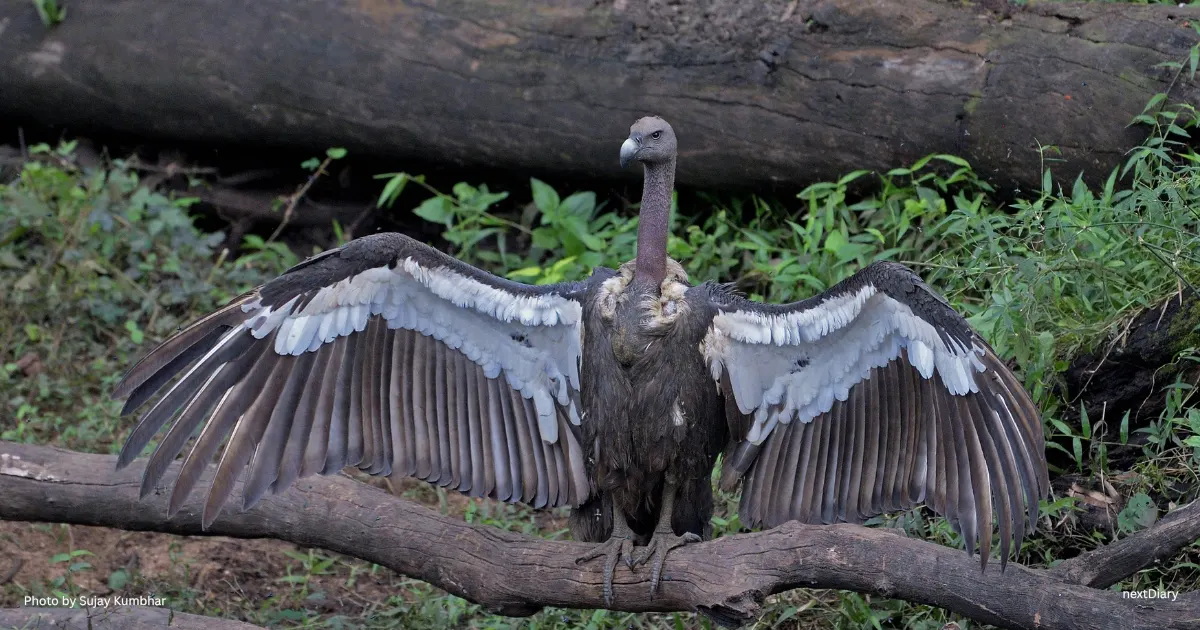

The first white-rumped vulture recorded in Cambodia’s Lumphat Wildlife Sanctuary since 2016 suggests years of painstaking conservation may finally be paying off, but experts warn the species remains one poisoned carcass away from another setback.
On a humid morning in June, conservationists scanning the canopy above Cambodia’s Lumphat Wildlife Sanctuary spotted a familiar silhouette that had been absent for a decade. A single white-rumped vulture circled above the forest before dropping towards a feeding site. For the survey team, it was more than another entry on a census sheet. It was the first confirmed record of the species here since 2016.
The bird’s return follows years of quiet work by rangers, conservationists and local communities after two poisoning incidents wiped out the sanctuary’s resident population. No one is claiming victory. One bird does not make a recovery. But after ten years of waiting, it is a reminder that extinction does not always advance in a straight line.
The sighting emerged during Cambodia’s annual vulture census, coordinated by NatureLife Cambodia with support from government agencies and conservation partners. Survey teams also recorded five red-headed vultures, including two juveniles, evidence that breeding continues within the protected landscape.
“It is an encouraging sign,” said Seng Kim Hout, Conservation Programme Manager at NatureLife Cambodia. “The return of the white-rumped vulture reflects years of protection, but it also reminds us how fragile these populations remain.”
A survivor of one of the world’s fastest bird declines
Few birds have suffered such a dramatic collapse as the white-rumped vulture (Gyps bengalensis).
Three decades ago it ranked among the most abundant large birds of prey in South Asia. Today it is listed as Critically Endangered by the International Union for Conservation of Nature (IUCN) after populations crashed by more than 99 per cent.
The cause became one of conservation biology’s defining detective stories.
Research published in Nature identified the veterinary painkiller diclofenac as the principal driver. Livestock treated with the drug retained residues after death. Vultures feeding on contaminated carcasses suffered acute kidney failure, often dying within days.
Cambodia largely escaped the widespread use of diclofenac that devastated populations elsewhere across the Indian subcontinent. That has left the country supporting one of the last viable populations of three Critically Endangered species: the white-rumped, slender-billed and red-headed vultures.
Yet that relative good fortune has never guaranteed safety.
Poison remains the greatest threat
Lumphat Wildlife Sanctuary’s last white-rumped vultures disappeared after two poisoning incidents in 2014 and 2016.
Unlike diclofenac, these deaths were linked to toxic bait, often intended for predators or scavenging mammals. Vultures simply became unintended victims after feeding on contaminated carcasses.
For birds that gather communally around food, poisoning is particularly efficient.
A single carcass can kill dozens of vultures within hours.
“Poisoning remains the greatest immediate threat to vultures across Southeast Asia,” said Dr Chris Shepherd, Executive Director of The Monitor Conservation Research Society, who has worked extensively on wildlife conservation across the region. “It only takes one incident to erase years of conservation effort.”
That vulnerability explains why conservationists celebrate even a lone returning bird.
Feeding stations buy precious time
A short drive from the survey site lies one of conservation’s more unusual interventions.
Known informally as a “vulture restaurant”, the feeding station supplies livestock carcasses that have been carefully screened to ensure they contain no harmful veterinary drugs or poisons.
The concept may sound curious, but its purpose is simple.
Provide predictable, uncontaminated food while reducing the risk that vultures feed on poisoned animals elsewhere.
NatureLife Cambodia organises regular supplementary feeding events throughout the year, particularly during periods when natural food sources become scarce.
The approach reflects a difficult reality. Cambodia’s remaining vultures have become conservation dependent.
“They still need safe food while wider threats persist,” Seng Kim Hout explained. “The long-term goal is healthy ecosystems where vultures no longer rely on supplementary feeding, but we are not there yet.”
Why vultures matter far beyond wildlife
Scavengers rarely attract the affection reserved for elephants or big cats.
Yet ecologists often describe vultures as nature’s sanitation workers.
Their exceptionally acidic digestive systems destroy dangerous bacteria that would survive inside most other animals. By consuming carcasses rapidly, they reduce opportunities for diseases to spread through wildlife, livestock and human communities.
The consequences of losing them became painfully clear in India.
Following the collapse of vulture populations, feral dog numbers increased around livestock carcasses. Several studies linked those changes to higher risks of rabies transmission and other public health costs running into billions of dollars.
The lesson reaches well beyond South Asia.
Protecting vultures is not simply about saving an unpopular bird. It also supports healthier ecosystems and healthier communities.
Conservation needs policy as much as passion
Cambodia’s vultures benefit from more than field surveys and feeding stations.
The country’s remaining populations receive protection through national wildlife legislation, while international trade is regulated under CITES, the Convention on International Trade in Endangered Species of Wild Fauna and Flora.
Those legal safeguards help prevent direct exploitation, but legislation alone cannot prevent poisoning or habitat loss.
Funding remains another challenge.
Many of Cambodia’s vulture conservation programmes rely on long-term partnerships between government agencies and organisations including NatureLife Cambodia, BirdLife International and the Royal Government of Cambodia.
Such projects rarely generate headlines.
They involve ranger patrols, veterinary monitoring, community engagement and countless early starts before sunrise.
That steady, often invisible work made this latest sighting possible.
A landscape still worth protecting
Lumphat Wildlife Sanctuary covers more than 250,000 hectares of forest and grassland in eastern Cambodia.
It shelters banteng, pileated gibbons, Asian elephants and one of Southeast Asia’s richest bird communities.
Its vultures sit at the very top of the scavenger food web.
When they disappear, something deeper is usually wrong.
When they return, conservationists know only one thing with certainty.
The landscape still holds enough ecological integrity to support them.
Whether that single white-rumped vulture becomes the first of many depends on decisions that extend far beyond one sanctuary.
Poison control, habitat protection, sustainable funding and continued monitoring will determine whether Cambodia remains one of Asia’s final refuges for these birds.
For now, the survey team has logged another annual census.
One extra bird appears on this year’s spreadsheet.
On paper, that hardly seems remarkable.
In conservation, however, a single line of data can represent ten years of patience, thousands of hours in the field and the possibility, still uncertain, that one of the world’s rarest scavengers has found its way home again.