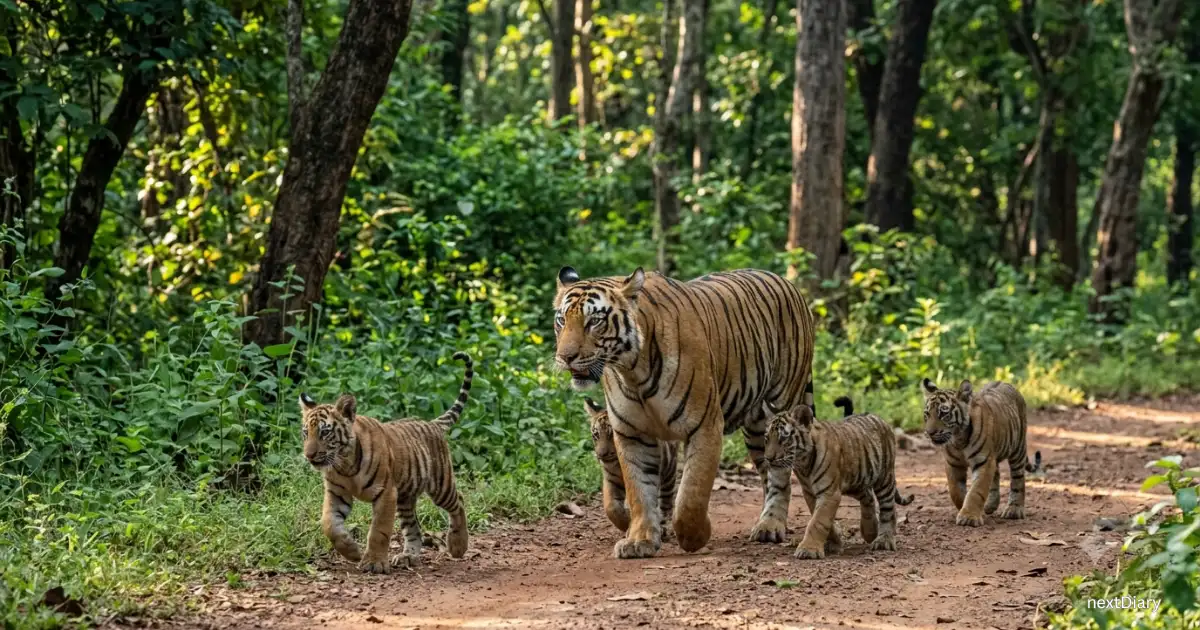

The first successful litter from a translocated tigress suggests one of India’s most ambitious tiger recovery projects may finally be taking root.
On 28 June, deep inside Odisha’s Similipal Tiger Reserve, camera traps captured a reassuring sight. Tigress Zeenat, once known more for an unexpected cross-country wander than for conservation success, was leading her four cubs through dense sal forest. For reserve managers, the images marked far more than a family outing. They signalled that an ambitious attempt to rebuild one of India’s most isolated tiger populations has reached a critical milestone.
The cubs have now begun moving with their mother, a stage that usually comes several weeks after birth when young tigers become strong enough to leave the security of their natal den. Forest officials say all four appear healthy, with Zeenat continuing to nurse and protect them while shifting between secure locations within the reserve.
For a project that has faced scrutiny from the outset, the photographs amount to its first convincing proof of success.
Why Zeenat matters
Similipal is unlike any other tiger landscape in India.
The reserve supports the world’s only known wild population of pseudo-melanistic tigers, often referred to as black tigers because unusually broad stripes merge across much of their bodies. Their striking appearance stems from a rare genetic mutation that became concentrated after decades of isolation.
Isolation, however, comes at a cost.
A small breeding population risks losing genetic diversity, increasing the chances of inherited disorders and reducing resilience to disease and environmental change. Recognising this, the National Tiger Conservation Authority (NTCA) approved a programme to introduce unrelated tigers from healthier populations into Similipal.
Zeenat became one of those pioneers.
Transferred from Maharashtra’s Tadoba-Andhari Tiger Reserve in 2024, she briefly became an unlikely celebrity after straying across several states before wildlife officials safely recaptured and returned her to Similipal. Some questioned whether the relocation programme had failed before it had properly begun.
Those doubts now look rather premature.
A cautious conservation success
“The cubs are healthy and have started moving with their mother,” reserve officials said after reviewing recent camera trap footage.
To reduce disturbance, managers have deliberately limited human access around the family’s range. Zeenat continues to wear a satellite radio collar, while teams track her movements using both GPS and very high frequency (VHF) telemetry. Nine forest personnel monitor the area in rotating shifts, allowing managers to assess the family’s welfare without direct interference.
That restrained approach reflects modern tiger conservation.
Dr Ullas Karanth, conservation scientist and director emeritus of the Centre for Wildlife Studies, has long argued that successful tiger recovery depends less on intensive management than on securing habitat, prey and protection from human disturbance. Once those ingredients exist, breeding females generally know exactly what to do.
That appears to be precisely what Zeenat is demonstrating.
The science behind moving tigers
Translocating large carnivores is never straightforward.
Every animal must establish territory, avoid conflict with resident tigers and learn unfamiliar landscapes before reproduction even becomes possible. Mortality can be high if habitat quality is poor or human pressures remain intense.
Dr Yadvendradev Vikramsinh Jhala, senior scientist at the Wildlife Institute of India and one of India’s leading tiger ecologists, has previously described genetic exchange between isolated populations as essential for maintaining healthy tiger populations over the long term.
For Similipal, that science carries unusual weight.
India now supports more than 3,600 wild tigers, according to the country’s latest national assessment. Yet many populations remain fragmented into isolated reserves separated by roads, settlements and farmland. Even where overall numbers are rising, some landscapes remain genetically vulnerable.
Introducing unrelated breeding animals can restore what conservation biologists call gene flow. In simple terms, it allows fresh genetic material to circulate through a population before inbreeding becomes an irreversible problem.
Beyond a single litter
The success of one tigress does not guarantee the success of an entire programme.
Four cubs must still survive their first difficult year. Young tigers face disease, injury, territorial conflict and the simple hazards of growing up in one of India’s largest forests. Mortality among cubs remains naturally high even under ideal conditions.
Nor is genetic rescue achieved through one breeding event alone.
Conservation managers will need to monitor whether Zeenat’s offspring survive to adulthood, disperse naturally and eventually reproduce themselves. Future introductions of additional tigers may still prove necessary to secure long-term genetic diversity.
The NTCA’s broader tiger conservation framework emphasises maintaining connected landscapes wherever possible, reducing the need for repeated human intervention. In landscapes like Similipal, however, isolation means carefully managed supplementation may remain an important conservation tool.
Watching the next chapter unfold
For now, forest staff continue their quiet routines.
Camera traps are checked. Satellite signals are logged. Patrol teams walk familiar forest tracks while deliberately keeping their distance from one of India’s most closely watched tiger families.
The photographs released this week are undeniably encouraging, but conservation has a habit of resisting tidy endings.
If Zeenat’s cubs survive to adulthood, they may reshape the genetic future of Similipal’s extraordinary tiger population. If they do not, the reserve’s long struggle against isolation will continue.
For the moment, though, a tigress is simply doing what wild tigresses have done for thousands of years: leading her cubs through the forest, one cautious step at a time. Sometimes, in conservation, that is precisely the breakthrough everyone has been waiting to see.