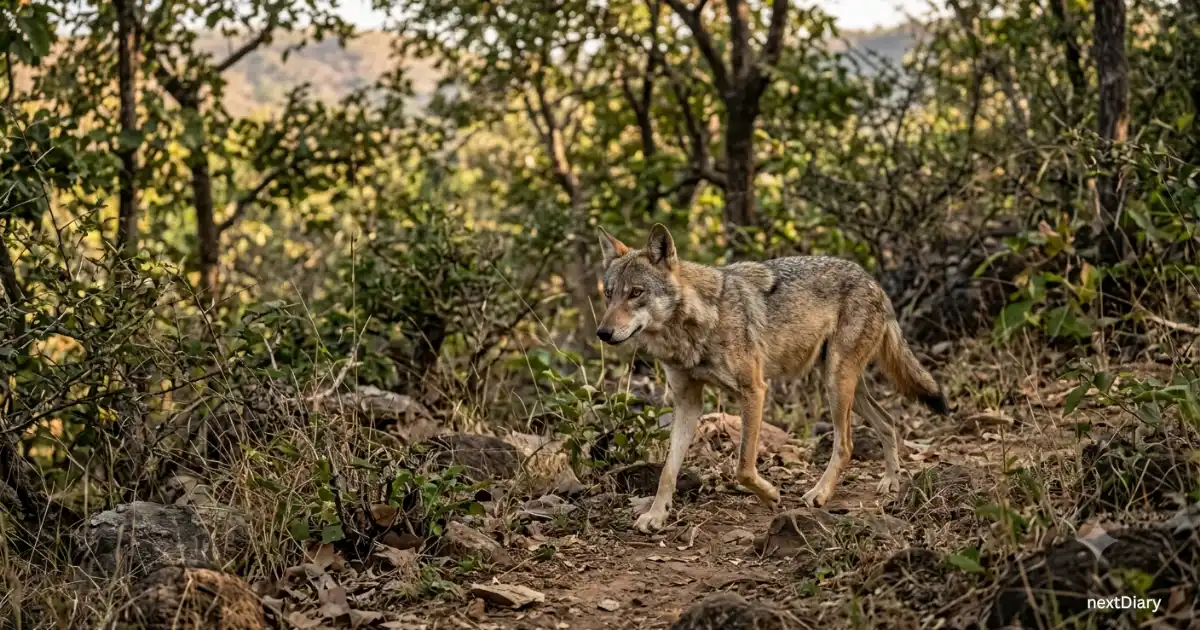

Camera trap images from Amrabad Tiger Reserve have revealed one of India’s most elusive carnivores, raising fresh questions about how the country’s neglected grasslands should be protected.
When forest officials reviewed thousands of camera trap images collected during India’s latest All India Tiger Estimation exercise, they expected to see tigers, leopards and perhaps the occasional sloth bear. Instead, hidden among the photographs from Amrabad Tiger Reserve in Telangana, a small pack of Indian grey wolves emerged from the scrub. For one of the country’s rarest large carnivores, it was an unexpected appearance.
The photographs, released by Telangana’s Forest Department, are thought to show five or six Indian grey wolves (Canis lupus pallipes). While the reserve is celebrated for its tigers, the discovery reminds conservationists that protected landscapes often shelter species that attract far less attention, yet face equally pressing conservation challenges.
The Indian grey wolf is listed in Schedule I of India’s Wildlife (Protection) Act, 1972, giving it the country’s highest level of legal protection. Even so, its future remains uncertain because legal protection alone cannot preserve disappearing habitat.
More than a tiger story
Most people associate wolves with vast forests or snowy mountains. India’s grey wolf tells a different story.
It has evolved to survive in dry grasslands, rocky plateaus and open scrub that stretch across central and western India. Those landscapes rarely receive the same conservation priority as forests, despite supporting an extraordinary range of wildlife.
“The Indian wolf is among our least understood large carnivores,” says Bilal Habib, senior scientist at the Wildlife Institute of India, who has spent years studying the species. “Its survival depends on open natural ecosystems that have historically been overlooked in conservation planning.”
Habib’s research has shown that wolves occupy remarkably large territories and frequently move across landscapes shared with livestock and people. That makes them especially vulnerable as agriculture, roads and industrial development continue to fragment grassland habitats.
The latest photographs suggest that parts of Amrabad Tiger Reserve still provide suitable habitat for the species, particularly where woodland gives way to open scrub and rocky plains.
Camera traps reveal unexpected residents
The wolf images emerged during the nationwide tiger census, one of the largest wildlife monitoring exercises ever undertaken.
Although the programme is designed primarily to estimate tiger numbers, its network of camera traps routinely captures hundreds of other species. Conservation scientists increasingly regard these surveys as valuable biodiversity inventories rather than simply tiger counts.
Officials involved in the Telangana survey also recorded leopards, dholes, sloth bears, chousingha, chinkara and evidence that the reserve’s mouse deer reintroduction programme is establishing itself.
That broader picture matters.
Large predators occupy the top of food chains. Their presence often indicates that prey populations remain healthy and that ecosystems retain enough space and ecological complexity to support species with very different habitat requirements.
India’s forgotten ecosystems
Grasslands present an awkward challenge for conservation.
Unlike dense forests, they are often dismissed as degraded or unused land. In reality, they rank among India’s most threatened ecosystems.
The International Union for Conservation of Nature (IUCN) has repeatedly warned that grassland specialists, including wolves, bustards and blackbuck, continue to decline as natural habitats are converted for farming, infrastructure and commercial plantations.
“Grasslands are every bit as important as forests,” says Vidya Athreya, conservation scientist with the Wildlife Conservation Society-India. “They support unique biodiversity, yet they remain poorly represented within our protected area network.”
Her work focuses largely on large carnivores living alongside people. She argues that protecting wolves demands a different approach from tiger conservation because wolves spend much of their lives beyond reserve boundaries.
That means working with pastoral communities, reducing livestock conflict and maintaining habitat corridors across multiple land ownerships.
Protection on paper is only the beginning
India’s Wildlife (Protection) Act, 1972 prohibits hunting of Indian grey wolves and affords the species the country’s strongest legal safeguards.
Yet conservationists point out that legislation cannot prevent habitat from gradually disappearing through piecemeal development.
Road expansion, renewable energy infrastructure, mining projects and agricultural intensification increasingly reshape semi-arid landscapes. Individually, each project appears manageable. Collectively, they fragment the wide-ranging territories wolves require.
The challenge extends beyond India.
The Convention on Biological Diversity’s Kunming-Montreal Global Biodiversity Framework calls on governments to conserve at least 30 per cent of land and sea by 2030 while improving ecosystem connectivity. For grassland predators such as the Indian grey wolf, connected landscapes may prove just as important as the protected areas themselves.
A reminder hidden among the tiger photographs
The discovery has also exposed one of wildlife monitoring’s quiet strengths.
Large-scale camera trap surveys generate enormous quantities of ecological information that often remain secondary to the headline results. Every leopard, civet, wolf or porcupine captured by those cameras contributes another piece to understanding how protected landscapes function.
Scientists caution that further monitoring will be needed before estimating the size or breeding status of the Amrabad population. One series of photographs cannot answer whether these wolves are permanent residents or part of a wider roaming population.
Even so, the images have expanded what conservationists know about one of India’s most elusive carnivores.
For a species that spends much of its life avoiding people, perhaps that is fitting. The wolves appeared only because researchers were looking for something else entirely. The greater question now is whether conservation policy will notice them before the landscapes they depend upon quietly disappear.