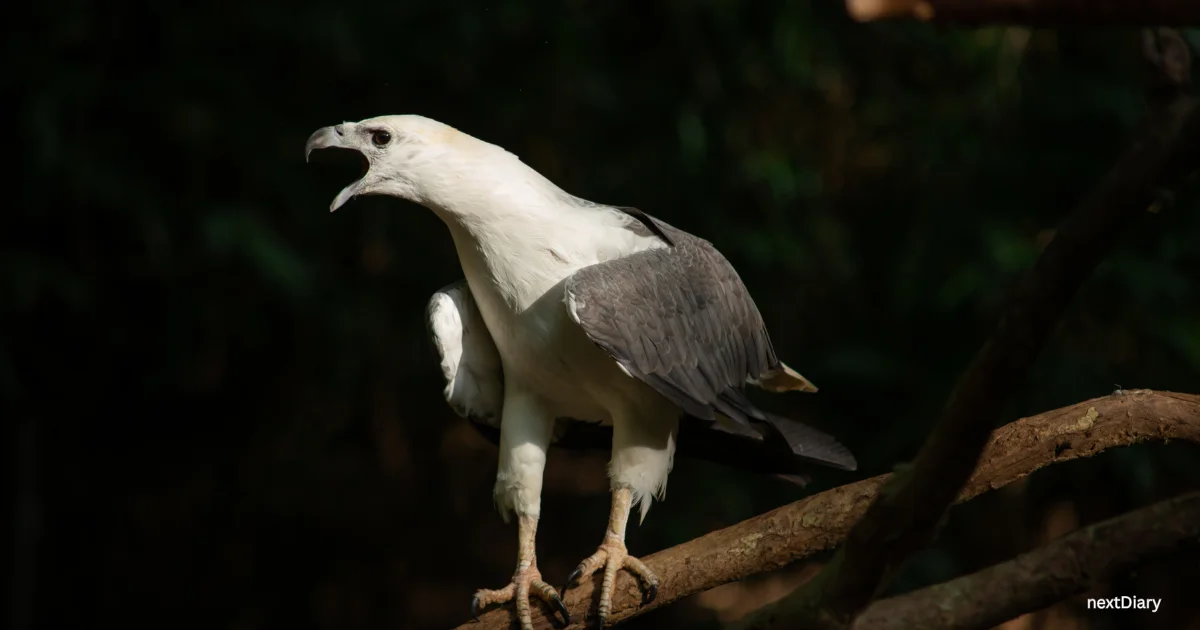

A five-year study along Tamil Nadu’s Gulf of Mannar reveals how the loss of mature coastal trees is forcing one of India’s largest birds of prey into an increasingly hazardous relationship with human infrastructure.
“Sea eagles are nesting on telecom towers.” Habitat loss is reshaping life along India’s coast
By the time researchers returned to the Gulf of Mannar this breeding season, the change was impossible to miss. White-bellied Sea Eagles that once nested high in sprawling coastal trees had shifted to electricity pylons and telecom towers instead, adapting to a landscape that is steadily losing the natural structures they have relied upon for generations.
The finding comes from a five-year study along Tamil Nadu’s coastline, where researchers have documented an increasingly uneasy compromise between one of India’s most recognisable raptors and a rapidly changing shore. The birds are still breeding. They are still raising chicks. But they are doing so in places that expose them to entirely new dangers.
For a species built to rule the coastline, the modern seascape is becoming less forgiving.
A coastline with fewer places to nest
The White-bellied Sea Eagle depends on large, mature trees close to productive fishing waters. These elevated platforms allow the birds to survey the coastline before sweeping down to catch fish or scavenge carrion.
Those trees are disappearing.
Researchers working across the Gulf of Mannar found that coastal development, infrastructure expansion and the gradual loss of native vegetation have reduced the number of suitable nesting sites. Faced with dwindling options, breeding pairs increasingly selected electricity transmission towers and telecommunications masts instead.
The shift illustrates a familiar pattern in conservation biology. Wildlife often appears remarkably adaptable until that adaptation begins to carry hidden costs.
“These structures may appear to solve one problem,” explained Dr R. Ramakrishnan, wildlife biologist and one of the researchers involved in the study. “But they expose both adult birds and newly fledged juveniles to collisions, electrocution and repeated human disturbance.”
Young sea eagles, making their first uncertain flights, face particular risks as they learn to navigate wires suspended around artificial nesting sites.
Success still depends on healthy habitat
The research nevertheless offered an unexpected note of encouragement.
During the latest breeding season, researchers recorded improved nesting success compared with previous years. More pairs successfully raised young, suggesting that where disturbance remains limited and food remains plentiful, the species retains considerable resilience.
That matters because White-bellied Sea Eagles occupy the top of the coastal food web. Healthy breeding populations often indicate healthy fish stocks, intact mangroves and productive estuaries.
Dr Ramakrishnan cautioned that improved breeding in a single season should not be mistaken for long-term security.
“The birds are responding to immediate conditions,” he said. “Without protecting nesting habitat, these gains may prove temporary.”
His team argues that safeguarding mature coastal trees remains considerably safer than relying on artificial structures that were never designed for wildlife.
Why old trees matter
Conservation discussions often focus on forests measured in hectares. For species such as the White-bellied Sea Eagle, individual trees can matter just as much.
A single large coastal tree may support generations of breeding birds. Sea eagles frequently reuse nests year after year, gradually expanding them into structures that can weigh hundreds of kilograms.
Lose that tree, and an entire breeding territory may disappear.
Dr Asad Rahmani, former Director of the Bombay Natural History Society, who was not involved in the study but has spent decades studying India’s birds of prey, said mature nesting trees remain one of the least appreciated elements of coastal conservation.
“Protecting wetlands alone is not enough,” he has frequently argued in discussions about raptor conservation. “You also have to protect the structures that allow these birds to breed.”
That principle increasingly applies across Asia, where coastal development often removes isolated old trees long before wider habitats disappear.
Conservation beyond protected areas
Much of the Gulf of Mannar falls within the Gulf of Mannar Marine National Park, while the surrounding biosphere reserve is recognised under UNESCO’s Man and the Biosphere Programme.
Protected status has undoubtedly preserved significant marine biodiversity. The region supports coral reefs, seagrass meadows, dugongs, dolphins and hundreds of fish species.
Yet sea eagles frequently nest beyond reserve boundaries.
Transmission lines, ports, roads and expanding settlements occupy the landscapes that connect protected habitats. Conservationists increasingly argue that safeguarding biodiversity requires managing these working landscapes just as carefully as national parks.
The study’s findings align with a broader trend reported in raptor research worldwide. Eagles, ospreys and other large birds of prey often adapt surprisingly well to human infrastructure, but only when the surrounding habitat remains capable of supporting them.
Artificial nests cannot compensate indefinitely for disappearing ecosystems.
What happens next?
The researchers recommend protecting remaining coastal nesting trees, restoring native vegetation and designing power infrastructure that reduces the risk of electrocution. Similar measures have proved effective for large raptors elsewhere by insulating dangerous equipment and maintaining safe distances between live wires.
They also call for continued long-term monitoring. Five years provides valuable insight, but coastal ecosystems continue to change under pressure from development, rising sea levels and increasingly unpredictable weather linked to climate change.
The White-bellied Sea Eagle is currently classified as Least Concern by the International Union for Conservation of Nature (IUCN). That global assessment reflects its broad distribution across the Indo-Pacific rather than the health of individual regional populations.
Local declines often begin quietly.
A pair abandons an old nesting tree. Another settles on a telecom mast. A chick survives its first flight, or it does not.
The Gulf of Mannar study suggests these choices are becoming less about preference than necessity. The question now is whether conservation can restore enough of the coast to give the birds a genuine choice once again.