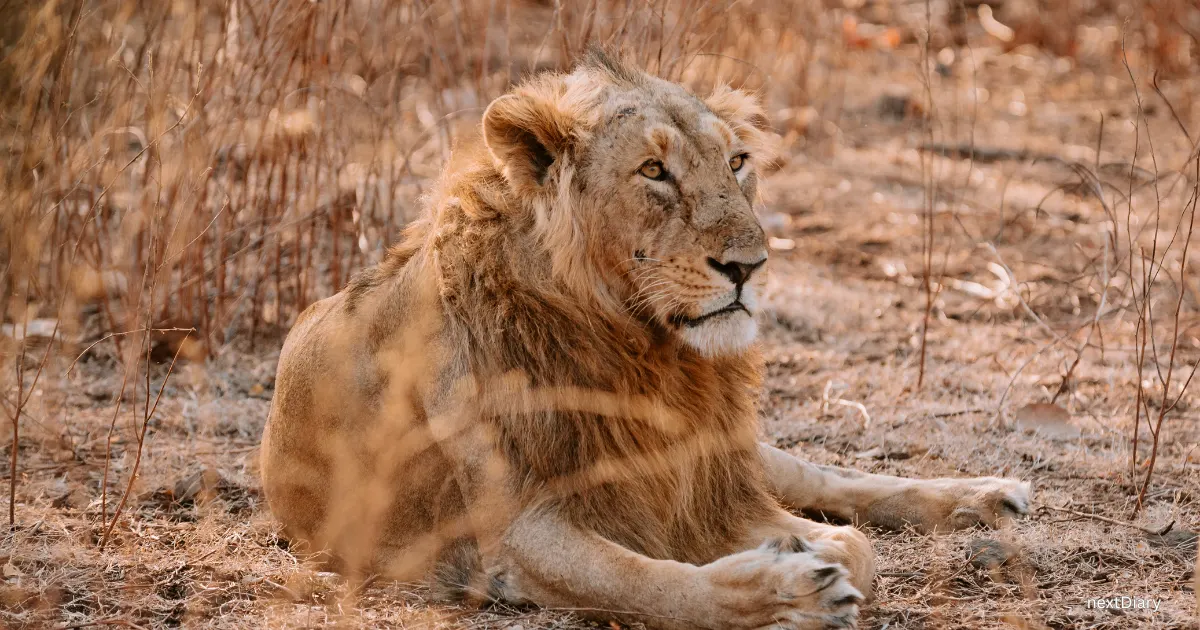

record numbers, every wild Asiatic lion still depends on a single landscape, leaving one of conservation’s greatest recoveries balanced on an increasingly narrow margin.
On a hot June morning in Gujarat’s Gir landscape, forest guards tracked another pride through teak woodland and scrub. The latest census had delivered a remarkable milestone. India now supports 891 Asiatic lions, the highest number ever recorded. Yet beneath the celebration lies an uncomfortable truth. Almost every wild Asiatic lion on Earth still occupies the same corner of western India, where a single disease outbreak, wildfire or environmental disaster could undo decades of painstaking recovery.
For conservationists, it is a paradox that has lingered for years. The population has grown steadily from barely 20 animals at the beginning of the twentieth century to nearly 900 today. By almost any measure, the recovery ranks among the world’s most successful carnivore conservation stories.
But numbers alone do not tell the whole story.
“If all your eggs are in one basket, that basket matters enormously,” says Yadvendradev Jhala, former dean of the Wildlife Institute of India and one of India’s leading carnivore ecologists. Population size reduces some risks. Geographic concentration magnifies others.
The debate is no longer about whether lions have recovered. It is whether conservation policy has kept pace with that success.
A recovery built on one landscape
The Gir Forest National Park and the wider Gir landscape have become synonymous with the Asiatic lion. Today the cats range far beyond the protected forest itself, dispersing across agricultural land, coastal scrub, revenue forests and villages throughout Gujarat.
That expansion partly explains the encouraging census figures. Nearly half of the population now lives outside formally protected areas.
For local communities, encounters with lions have become increasingly common. Maldhari pastoralists have coexisted with the predators for generations, while forest officials have developed rapid response teams to deal with wandering animals entering settlements or industrial areas.
The success owes much to sustained protection by the Gujarat Forest Department, reduced poaching and strong local tolerance. It also reflects decades of political commitment that many threatened large carnivores elsewhere have lacked.
Yet conservation biology has long warned against relying upon a single population, however healthy it appears.
Why one disease could change everything
The warning became starkly real in 2018.
An outbreak of canine distemper virus, coupled with babesiosis, a tick-borne disease, killed more than 20 lions within weeks in the Gir landscape. The episode echoed a catastrophe seen two decades earlier in Tanzania’s Serengeti, where canine distemper virus killed around a third of the lion population.
“The Gir outbreak was a wake-up call,” says Ravi Chellam, wildlife biologist and Chief Executive of the Metastring Foundation. Diseases spread rapidly when animals occur at high density, particularly if they occupy connected habitats.
Climate change may compound those risks. More frequent heatwaves, prolonged droughts and increasingly erratic monsoon rainfall alter prey availability, increase pressure around water sources and may favour the spread of certain pathogens.
Wildlife epidemiologists increasingly argue that disease surveillance deserves the same attention as anti-poaching patrols.
The long-running dispute over a second home
Scientists have advocated establishing a second free-ranging population for more than three decades.
The proposed destination is Kuno National Park in Madhya Pradesh, where villages were relocated and habitat restored specifically to receive Asiatic lions.
In 2013, India’s Supreme Court ordered that lions should be translocated to Kuno, describing the move as essential insurance against extinction. The judgment reflected recommendations made by the Wildlife Institute of India and conservation scientists who argued that no single population, however successful, should remain geographically isolated.
The transfer has yet to happen.
Instead, Kuno became the release site for African cheetahs under Project Cheetah, a programme designed to restore the species to India after its local extinction in the twentieth century.
That decision has reignited debate among conservationists over competing priorities for large carnivore restoration.
Ramesh Pandey, a former senior official with the Indian Forest Service, argues that creating multiple populations is standard conservation practice worldwide. “Redundancy is not waste,” he has previously observed. “It is resilience.”
More lions, more conflict
Population growth has also brought fresh challenges beyond disease.
As lions disperse into human-dominated landscapes, collisions with trains and vehicles, falls into open wells and accidental electrocution have become recurring causes of mortality.
Livestock depredation inevitably increases where predators expand their range, although compensation schemes have helped sustain local acceptance.
The International Union for Conservation of Nature (IUCN) continues to classify the Asiatic lion as Endangered, recognising that the entire wild population remains vulnerable because of its restricted distribution.
Under the Convention on International Trade in Endangered Species of Wild Fauna and Flora (CITES), international commercial trade in wild Asiatic lions is tightly controlled, but trade restrictions offer little protection against threats emerging within the species’ only remaining stronghold.
For many conservation biologists, habitat security now matters as much as anti-poaching measures once did.
Success demands a different kind of thinking
Conservation often celebrates rising numbers because recovery is so rare.
The Asiatic lion deserves that recognition. Few large carnivores have returned so dramatically from the brink.
Yet success alters the questions scientists must ask.
Instead of how to save the final population, attention shifts towards how to secure several populations capable of surviving independent catastrophes. That principle underpins modern conservation planning for wolves, black-footed ferrets and California condors alike.
The lion has become both a conservation triumph and a test of whether governments can act before disaster forces their hand.
As Jhala and many others have argued, insurance populations are established not because failure is inevitable, but because uncertainty always remains.
Nearly 900 lions now roam Gujarat’s forests and farmland. It is an extraordinary achievement.
Whether future generations inherit one thriving population or several resilient ones may depend less on how many lions exist today than on where tomorrow’s lions are allowed to live.