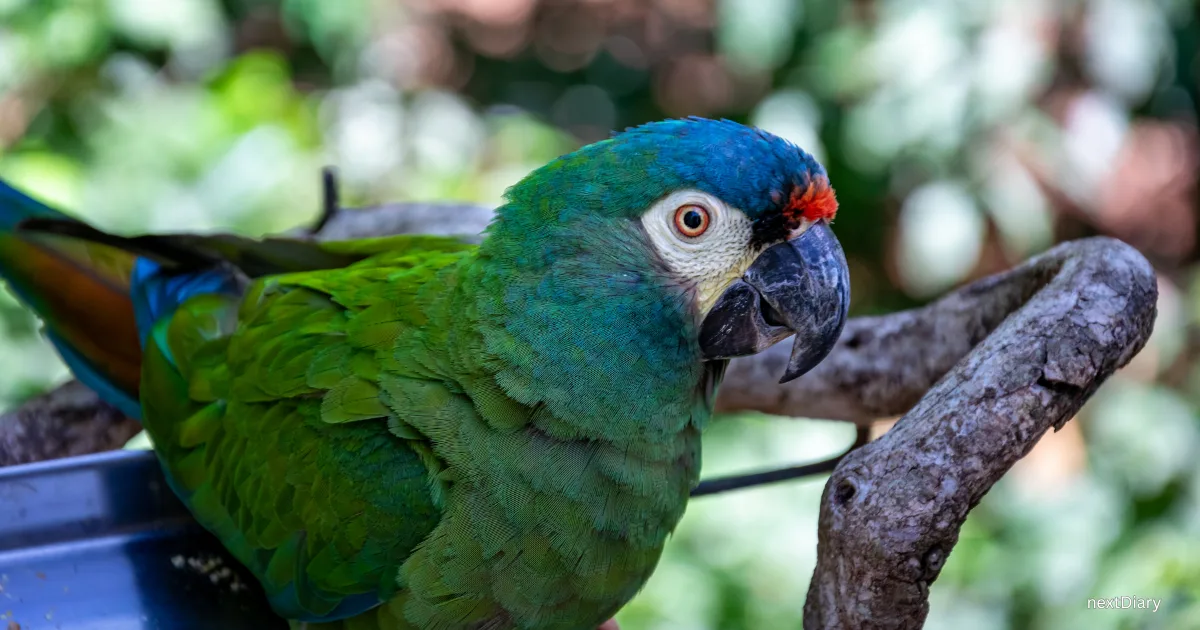

After disappearing from Argentina’s forests more than 50 years ago, blue-winged macaws are poised for a carefully managed comeback that could help restore one of South America’s most threatened ecosystems.
In a quiet forest enclosure in Misiones Province, Argentina, a flock of blue-winged macaws wheels overhead before settling noisily into the canopy. Their calls are unmistakably wild, although many of these birds spent years in cages after being rescued from the illegal pet trade. If all goes to plan, September will mark the first time in decades that the species has flown free in Argentina.
For the conservationists watching from behind concealed screens, this is the culmination of years of patient preparation. The birds have been taught to recognise native food plants, avoid predators and interact with one another with as little human contact as possible. It is rehabilitation measured not in weeks, but in years.
The release, coordinated by Fundación Temaikèn and conservation partners, represents one of Argentina’s most ambitious bird reintroduction projects. Yet it is about considerably more than returning a colourful parrot to the forest. It is an attempt to restore ecological functions that disappeared alongside the species itself.
Why did the blue-winged macaw disappear?
The blue-winged macaw (Primolius maracana) once ranged across large areas of eastern South America, including Argentina, Brazil and Paraguay. In Argentina, however, extensive forest clearance and decades of trapping for the international pet trade gradually erased the species from the wild.
Although populations remain elsewhere, they are increasingly fragmented.
“The disappearance of large parrots leaves a gap that forests cannot easily fill,” explains Luis Segura, ornithologist at Argentina’s National Scientific and Technical Research Council (CONICET). Seed dispersal depends on mobile animals capable of travelling long distances, and macaws perform that role exceptionally well.
Many tree species rely on birds such as these to transport seeds beyond the shadow of the parent tree, giving young plants a better chance of survival. Remove the birds, and forests gradually lose one of their most effective natural regeneration systems.
Teaching captive birds to become wild
Releasing a rescued bird is not as simple as opening a cage door.
Many of the macaws destined for release entered rehabilitation after authorities confiscated them from wildlife traffickers or private collections. Some had spent years living alongside people. That creates behavioural challenges that conservationists must painstakingly reverse.
Inside specially designed aviaries, the birds practise sustained flight, forage on native fruits and learn to identify suitable nesting sites. Human interaction is deliberately limited.
“These are not pets being returned to nature,” says Marcela Orozco, conservation manager at Fundación Temaikèn. “Every decision is aimed at ensuring they behave like wild macaws before they ever leave the aviary.”
Veterinarians also screen every individual for infectious diseases. Introducing pathogens into small recovering populations would undermine years of conservation work.
The birds will carry lightweight transmitters after release, allowing researchers to monitor survival, movements and breeding behaviour throughout the coming years.
Restoring an ecosystem, not simply a species
The project unfolds within the Atlantic Forest, one of the world’s richest biodiversity hotspots and one of its most fragmented.
More than 80 per cent of the original forest has disappeared through agriculture, logging and urban development. What remains survives as isolated fragments spread across Argentina, Brazil and Paraguay.
That matters because healthy forests depend upon complex ecological relationships.
Macaws consume hard fruits that many smaller birds cannot open. They disperse seeds over considerable distances, linking isolated forest patches in ways that machinery or tree planting programmes cannot replicate.
“The objective is ecosystem restoration,” says Fernando Miñarro, Conservation Director at Fundación Vida Silvestre Argentina, the Argentine partner of WWF. “Returning one species can help rebuild ecological processes that benefit many others.”
Those other species include jaguars, lowland tapirs and brown howler monkeys, all of which depend upon the remaining Atlantic Forest for survival.
The shadow of the wildlife trade
The blue-winged macaw remains listed under the Convention on International Trade in Endangered Species of Wild Fauna and Flora (CITES), the international agreement that regulates global wildlife trade.
Despite legal protections, illegal trafficking continues across parts of South America.
Parrots remain particularly vulnerable because their intelligence, colourful plumage and ability to mimic sounds make them highly desirable in the exotic pet market. Yet removing breeding adults from already fragmented populations has consequences that extend far beyond the individual bird.
Conservationists increasingly argue that tackling demand remains just as important as strengthening law enforcement.
Without reducing the incentive to capture wild birds, reintroduction projects risk becoming expensive exercises in replacing animals that trafficking continues to remove.
Success will take years to measure
Unlike headline-grabbing species recoveries, there is unlikely to be a single moment when conservationists declare victory.
Researchers will watch for quieter milestones instead.
Do the birds survive their first winter? Do they establish territories? Can they find mates? Most importantly, do wild-born chicks eventually leave nests that their parents selected without human assistance?
Those questions may take years to answer.
The project also reflects a wider shift within conservation science. Rather than focusing solely on preventing extinctions, practitioners increasingly aim to restore ecological functions that have gradually disappeared from damaged landscapes.
Evidence from rewilding projects elsewhere suggests that restoring missing species can trigger broader ecosystem recovery. Yet every landscape responds differently, and success remains difficult to predict.
As the first release date approaches, the aviaries in Misiones are becoming quieter. The birds spend less time watching their keepers and more time watching one another.
That, perhaps, is the most encouraging sign of all.
Soon the doors will open. Whether the Atlantic Forest is ready for the return of one of its missing gardeners is a question only time, and the birds themselves, can answer.