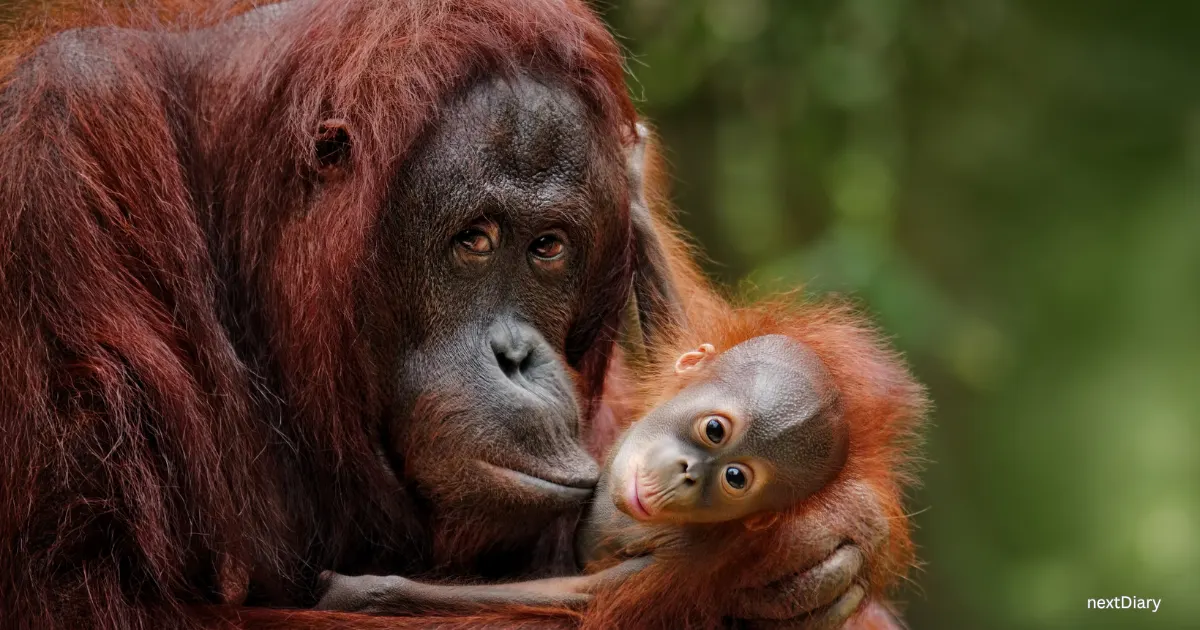

Four days of extraordinary rain in Sumatra appear to have wiped out about 7 per cent of the world’s rarest great ape, exposing how climate shocks now collide with old-fashioned habitat loss in one of Asia’s most contested forests.
On 28 November 2025, satellite images of Sumatra’s Batang Toru forest began to show the sort of damage conservationists had feared but could not yet count: long pale scars cut through dark canopy, whole hillsides peeled open by rain. By the time researchers finished mapping the destruction, they had identified 8,303 hectares of landslide damage across the West Block of the ecosystem, the largest stronghold of the Tapanuli orangutan. Their conclusion is a grim one. Around 58 of the great apes may have died in just four days.
For a species with fewer than 800 individuals left in the wild, that is not a bad year. It is a demographic jolt.
The Tapanuli orangutan, Pongo tapanuliensis, was only recognised as a distinct species in 2017. It survives in three isolated forest blocks in North Sumatra and nowhere else on Earth. Even before Cyclone Senyar arrived in late November last year, its future looked brittle.
Now the figures published in Current Biology suggest that one extreme weather event may have removed roughly 7 per cent of the global population and about 11 per cent of the animals in the West Block, where the storm hit hardest.
How four days of rain became a conservation crisis
Cyclone Senyar was not, on paper at least, the sort of event that would register globally. It was a regional storm system that dumped extraordinary amounts of rain across northern Sumatra between 23 and 28 November 2025. In parts of the wider region, rainfall exceeded 1,000mm in five days. In the orangutans’ West Block, more than 560mm fell over the same period, including two days above 150mm.
That mattered because Batang Toru is steep country. Much of the remaining orangutan habitat lies across dissected hills and deeply incised valleys. When the soil becomes saturated there, gravity takes over.
“These are high-velocity, shallow landslides triggered by intense rainfall,” said David Petley, a landslide researcher at Nottingham Trent University and one of the paper’s co-authors. The flows, he added, move rapidly into channel systems and become exceptionally destructive.
That is a clinical way of describing what happens when a forested slope suddenly liquefies. Trees come down with it. Mud, rock and timber funnel into ravines. Anything in their path has little warning and very little chance of getting clear.
Erik Meijaard, lead author of the study and managing director of Borneo Futures, said the team overlaid fresh landslide mapping with orangutan density estimates to work out how many animals had likely been in the affected areas. The answer, he said, was deeply troubling, even before one considers the losses the study could not measure.
Those 58 deaths are best understood as a conservative estimate. The analysis did not include animals injured outside the mapped scars, deaths caused by canopy collapse beyond the landslide zones, or the longer-term effects of food shortages in damaged forest.
Why 58 orangutans matter more than 58 usually would
Conservation reporting often falls into the trap of making every loss sound equally grave. In population biology, it plainly is not.
Tapanuli orangutans reproduce at a glacial pace. Females give birth only once every six to nine years, one of the slowest reproductive rates in the mammal world. A population can absorb occasional shocks if numbers are large and habitat is connected. Batang Toru offers neither luxury.
Previous modelling has suggested that sustained losses of more than 1 per cent a year could push the species towards extinction. That gives the new estimate its force. This was not 1 per cent. It was several times that, in a single event, in the species’ most important remaining refuge.
“It is tragic to lose so many apes in this way,” Serge Wich, a primatologist at Liverpool John Moores University and co-author of the study, said when the findings were released. In small, fragmented populations, he noted, climate or weather events can have consequences at the level of the whole species.
There is another problem, less dramatic but no less important. Landslides do not merely kill animals in the moment. They also alter the landscape survivors depend on. Topsoil is stripped away. Fruiting trees are lost. Broken canopy forces orangutans to descend more often or take longer, more energetically costly routes through the forest.
For an ape that already lives on a tight daily energy budget, that matters. More climbing and more ground travel mean less time feeding, greater risk of conflict, and potentially lower reproductive success in the years ahead.
The paper suggests that some damaged areas may offer little meaningful food for five to 10 years, until pioneer vegetation and then more mature forest begin to return. In the arithmetic of extinction risk, that lag is not a footnote. It is part of the story.
Climate change is now a direct killer, not a background threat
The striking thing about this study is not simply that climate change made conditions worse. It is that the authors argue climate change may now be acting as an immediate mortality driver for a great ape species already on the brink.
An attribution analysis linked to the research found that human-induced climate change increased the rainfall intensity associated with Cyclone Senyar by between 9 and 50 per cent. Friederike Otto, professor of climate science at Imperial College London and one of the researchers involved in the attribution work, said the findings show how tightly the climate and biodiversity crises are now bound together. Extra heat in the atmosphere means heavier rain; heavier rain on degraded, unstable slopes means landslides; landslides in the last home of a critically endangered ape mean dead orangutans.
That chain is not especially complicated. Nor is it comforting.
For years, climate change in wildlife stories has often sat in the background as a looming force that shifts ranges, alters flowering times or nudges breeding seasons out of step. Batang Toru suggests something harsher. In some places, it is no longer merely reshaping ecosystems. It is killing individuals outright, and in numbers large enough to alter the future of a species.
But climate is only half the story in Batang Toru
To say Cyclone Senyar killed these orangutans is true. It is not, however, the whole truth.
Batang Toru is not an untouched rainforest brought low by freak weather. It is a fragmented, pressured landscape that has spent years absorbing roads, forest clearance, mining and a controversial hydropower scheme. The Tapanuli orangutan’s surviving range has already been squeezed into a patchwork of steep upland forest, much of it more exposed to landslide risk than the lowland habitat the species historically occupied.
That context matters because extreme weather does not strike a vacuum. It strikes landscapes already shaped by human decisions.
In January, the Indonesian government revoked the permits of 28 companies after post-disaster audits found environmental violations linked to the late-2025 floods and landslides across Sumatra. Two of the most closely watched cases were in Batang Toru itself: the Batang Toru hydropower project run by PT North Sumatra Hydro Energy, and the Martabe gold mine operated by PT Agincourt Resources.
Both projects have long been criticised by conservationists because they sit inside or alongside the only habitat of the Tapanuli orangutan. Campaigners argue that forest clearing, road building and slope disturbance have added stress to an ecosystem already prone to failure during heavy rain.
There is still dispute over exactly how much particular developments contributed to the landslides in the orangutans’ West Block. Meijaard himself has been careful not to overstate that link, noting earlier this year that many of the slides appeared to be driven primarily by extreme rainfall in steep interior forest. But that caveat should not be mistaken for exoneration of industrial pressure more broadly.
The larger point is that Batang Toru has become less resilient. Forest fragmentation narrows escape routes. Roads split habitat. Clearance destabilises slopes and pushes wildlife into smaller, poorer patches. Then a storm arrives and turns a fragile system into a lethal one.
What would a serious rescue plan look like?
The scientists behind the new study are not short of suggestions. The problem is less a lack of ideas than a lack of political follow-through.
One proposal is to give Batang Toru stronger legal protection as a National Strategic Area, recognising it not simply as orangutan habitat but as a landscape critical to climate resilience and watershed protection. Another is to expand available habitat beyond the current core range, rather than trying to keep a tiny population alive in an ever more crowded fragment of forest.
Wich has also pointed to the need to reconnect the forest blocks. Roads currently help sever the east and west populations. In principle, wildlife bridges or other connectivity measures could ease movement and improve the odds of dispersal and genetic exchange.
Then there is money. Conservation plans are cheap to announce and expensive to run. Meijaard and colleagues have argued for a properly funded, landscape-scale species action plan involving government agencies, NGOs, scientists and industry. Jatna Supriatna, the Indonesian conservation biologist at Universitas Indonesia who also worked on the research, put it bluntly when the study was released: if the world wants to avoid the first modern extinction of a great ape species, Batang Toru must be protected permanently, and international partners need to help pay for biodiversity recovery.
That is the awkward bit of the story. The Tapanuli orangutan is an Indonesian species, but the climate forces intensifying the rain are global, and the commodity pressures eating away at its forest are tied to international markets and investment. Responsibility, in other words, is widely distributed. So, rather inconveniently, should be the bill.
What happens next for the world’s rarest great ape
For now, the 58 deaths remain an estimate, albeit a carefully modelled one. Some uncertainty is unavoidable in a disaster that unfolded across steep rainforest in the middle of a storm. Scientists still need to understand the full ecological aftershocks: whether surviving orangutans shift range, how badly food supplies are hit, whether reproduction drops, and how much more mortality follows in the months and years after the landslides.
That uncertainty cuts both ways. It means the exact toll may never be known. It also means the figure could yet prove to be an underestimate.
In Batang Toru, the forest will green again, at least in places. Pioneer plants will colonise the scars, then shrubs, then young trees. But forests recover on their own timetable, and orangutans do not have much time to spare. A species that was only formally described nine years ago is already being asked to survive a convergence of threats that would test a population ten times its size: habitat fragmentation, industrial encroachment, conflict with people, and now climate-fuelled disasters powerful enough to erase years of conservation effort in less than a working week.
The question hanging over Batang Toru is no longer whether climate change threatens the Tapanuli orangutan. It plainly does. The harder question is whether governments, companies and funders are prepared to act as if that were true before the next storm decides the matter for them.