
Tamil Nadu’s latest Nilgiri tahr survey suggests the state animal is recovering, yet the harder work now lies beyond the census: restoring the shola-grassland mosaic that keeps the species alive.
On the last weekend of April, teams of forest staff, scientists and volunteers spread out across the high folds of the Western Ghats, from Ashambu Mottai in Kanniyakumari to Tavalamalai in Gudalur, counting a mountain ungulate that once seemed in danger of slipping quietly out of view. By the time Tamil Nadu released the findings in early June, the tally stood at 1,364 Nilgiri tahrs: up from 1,303 last year and 1,031 in 2024. For a species found nowhere on Earth except India’s southern mountains, that is the sort of figure conservationists are entitled to welcome, albeit with the sort of caution mountain weather tends to teach.
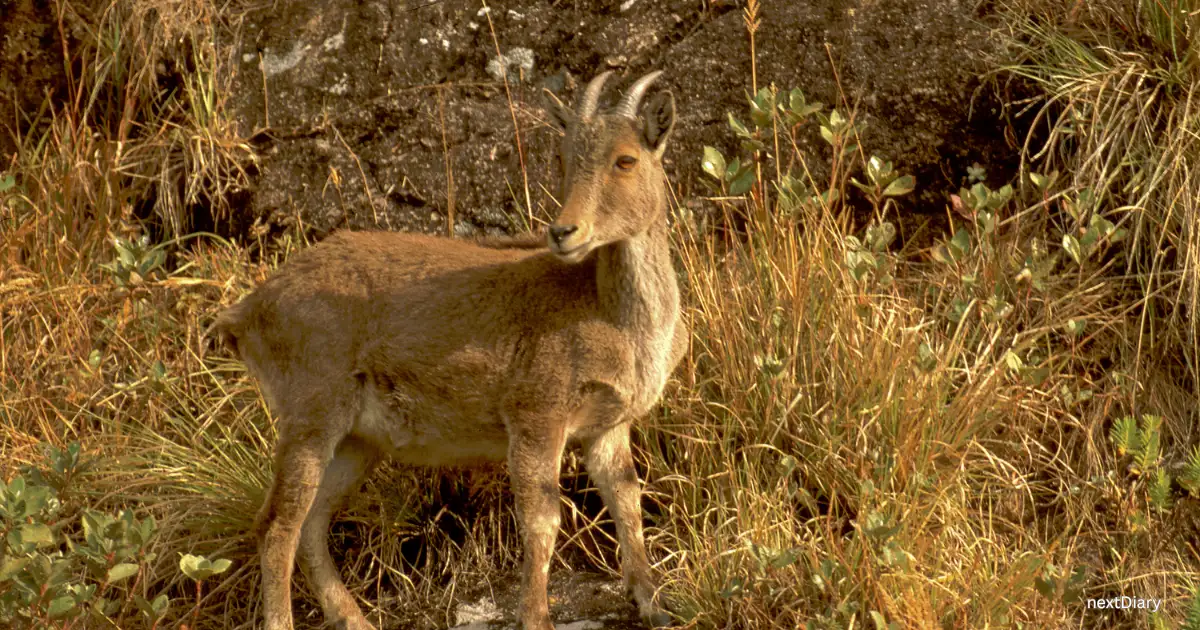
The Nilgiri tahr, Tamil Nadu’s state animal, is an Endangered goat-antelope of steep escarpments, montane grasslands and cliff edges. It is one of those species that looks perfectly engineered for gradients most people would prefer not to think about. Sure-footed and compact, it lives where grassland meets rock and where visibility, for both predator and prey, matters.
Tamil Nadu’s third synchronised survey, conducted between 24 and 27 April in coordination with Kerala, covered 177 survey blocks across 14 tahr-bearing forest divisions. The state says the population has risen by 4.68 per cent in a year and by more than 32 per cent since the first count under Project Nilgiri Tahr in 2024.
Those are solid gains. They are not, however, the whole story.
A census is not the same thing as recovery
The strongest populations remain where one would expect them to be. The Anamalai landscape accounted for nearly 45 per cent of the animals recorded in Tamil Nadu, with the Nilgiris holding just over 29 per cent. In other words, a species spread across a long arc of the Western Ghats still depends heavily on a few core landscapes.
That matters because abundance and resilience are not the same thing. A species can rise numerically while becoming ever more concentrated in habitat fragments that are easier to protect, easier to count and harder to connect.
“Population increase is encouraging, but the real question is whether those herds are connected and whether the grasslands they depend on are improving,” says Predit M.A., a wildlife biologist who has studied Nilgiri tahr and co-authored work on the species for WWF-India. Tahr, he notes, are not simply animals of “forest” in the broad bureaucratic sense. They are specialists of the shola-grassland mosaic, a high-altitude system that has been repeatedly misunderstood, planted over and broken up.
That distinction is important. In the Western Ghats, “restoration” has not always meant restoring the right thing. For decades, montane grasslands were often treated as wasteland or empty space, suitable for commercial plantations or tree planting. For Nilgiri tahr, they are the point.
What Project Nilgiri Tahr is trying to fix
Project Nilgiri Tahr, launched by the Tamil Nadu government in 2023, was billed as the first state-led programme focused entirely on recovering the species. It set out to do several things at once: survey the population properly, understand habitat use, reintroduce the animal into parts of its former range and tackle the pressures that have shrunk and fragmented its grassland habitat.
In one respect, the project has already changed the terms of the debate. The state now has annual, synchronised counts rather than sporadic estimates stitched together from different years and methods. This year’s exercise used a mobile application, VARUDAI, to standardise field records and GPS-tag observations in near real time. That may sound like a dry administrative upgrade. It is not. For a species spread across cliff country and state boundaries, better data means fewer duplicate counts, clearer trend lines and a more honest sense of where animals are, and are not.
“Simultaneous surveys with Kerala are essential,” says a senior Tamil Nadu forest official involved in the exercise, who points to the simple problem of mobile animals on porous boundaries. “If you count on different days, you risk counting movement rather than population.”
That problem is especially acute in the Anamalai and high-range landscapes, where Tamil Nadu and Kerala share ecologically continuous habitat but not always management priorities.
The trouble with grasslands that people keep trying to turn into something else
If there is a single theme running through the Nilgiri tahr story, it is habitat. Not just how much of it remains, but what state it is in.
The species historically ranged along roughly 400km of the southern Western Ghats, but much of that range has been thinned into isolated pockets. WWF-India has previously described the surviving populations as fragmented and under pressure from habitat loss, old plantation expansion, livestock competition and occasional hunting. Scientific work has also pointed to the Palghat Gap as a significant biogeographic divide, with northern and southern tahr populations showing genetic separation. That may be interesting to evolutionary biologists. It is also a practical warning to conservation managers: isolated herds do not remain healthy by default.
Raman Sukumar, ecologist and honorary professor at the Centre for Ecological Sciences, Indian Institute of Science, has been among those arguing that Western Ghats conservation must stop treating montane grasslands as expendable. When those grasslands are lost to wattle, eucalyptus, pine or other invasive and planted species, tahr lose forage, visibility and access to the steep open slopes that keep them safe.
And then there is fire. Tamil Nadu’s own survey release noted that forest fires appear to have curbed the pace of population growth this year. That does not mean fire is uniformly bad. Grassland systems are more complicated than that, and fire ecology in the Ghats is not reducible to a slogan. But repeated, poorly timed or intense fires in already stressed habitat can degrade forage and alter plant communities in ways that matter to a grazer living close to the ecological margins.
Counting animals is the easy bit. Rebuilding landscapes is harder
There is a temptation, with any positive census result, to tell a neat recovery story. Politicians like them because they are legible. Conservationists like them because they can unlock funding. Journalists like them because they provide a headline with a number in it.
The Nilgiri tahr resists tidy narratives.
Tamil Nadu’s figure of 1,364 is a state figure, not a total for the species. Kerala’s last synchronised estimate, released in 2025, counted 1,365 tahrs, with Eravikulam National Park alone holding 841 animals, around 90 per cent of the state’s population. Put differently, a large share of the world’s Nilgiri tahrs remains concentrated in a handful of strongholds across two states. That is better than losing them altogether, but it is not a comfortable place from which to manage climate stress, disease, landslips, invasive spread or political drift.
Nor is every intervention automatically a good one. Kerala’s discussion last year of translocating tahrs from Eravikulam prompted caution from some wildlife biologists, who argued that improving habitat and connectivity should come before moving animals around as if they were counters on a map. It is a useful reminder that conservation can go wrong when the pressure to be seen doing something outruns the evidence for what works.
Predit M.A. puts it more gently. The survey gains, he says, should now be used to direct “site-specific habitat management”, especially in smaller, isolated populations where a few bad years could erase progress quickly.
What happens next
The next phase of Project Nilgiri Tahr will matter more than the launch phase. Radio-collaring and movement studies may help identify barriers between herds. Grassland restoration, if done properly, could reopen some of the habitat lost to invasive plants and old land-use decisions. Reintroduction to former range may yet have a place, but only if the habitat can support it and the reasons for the species’ disappearance have first been dealt with.
There is also a broader policy lesson here. India’s conservation system is still far more comfortable protecting charismatic forest species in forests than protecting awkward, open, high-altitude habitats that do not conform to the popular image of a lush wilderness. The Nilgiri tahr is a reminder that biodiversity policy often hinges on whether officials can value a landscape before it turns into a plantation, a tourism asset or a map category convenient for somebody else.
For now, Tamil Nadu can reasonably claim a conservation success. An Endangered mountain ungulate has risen, at least in the state count, for three consecutive years. In a century not exactly overflowing with uncomplicated wildlife news, that is worth saying plainly.
But on the upper slopes of the Ghats, where grasslands fray into mist and cliffs fall away into tea and timber, recovery still looks fragile. A census can tell you how many tahrs were standing there in April. It cannot, on its own, tell you whether there will be room for them in ten years’ time.