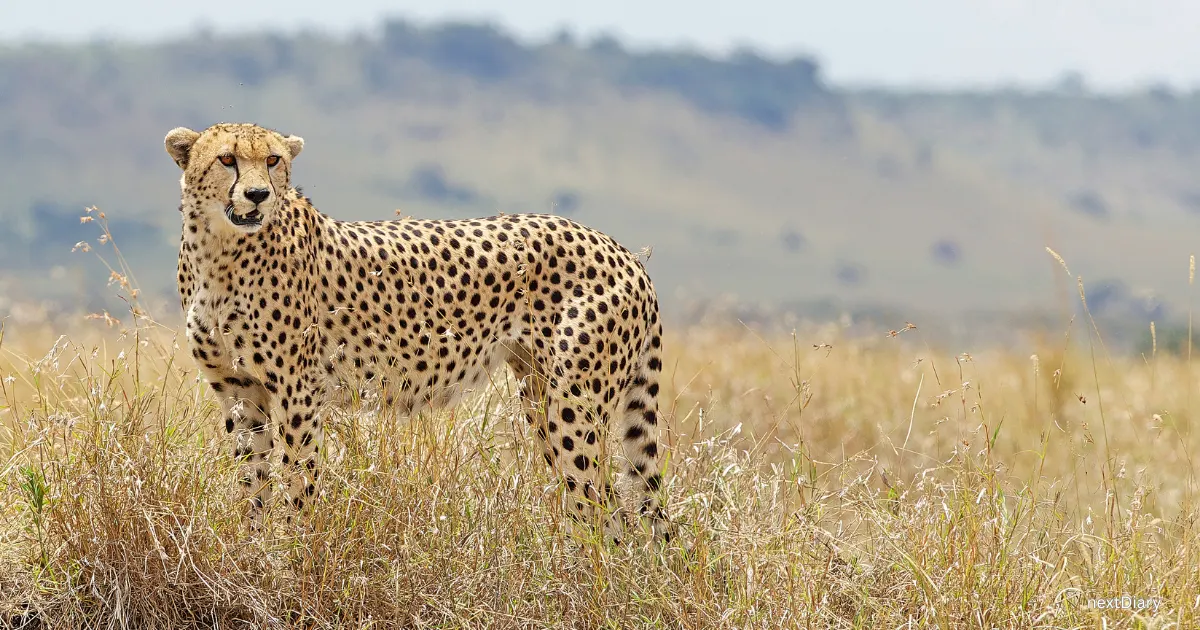

Two more female cheetahs from Botswana have been released into the open forest at Kuno National Park, taking the number of free-ranging cats there to 16. It is a welcome milestone for Project Cheetah, but it also sharpens the central question hanging over India’s most closely watched reintroduction: can this become a genuinely wild, self-sustaining population, or will it remain a heavily managed one?
On 15 May, in the dry teak-and-scrub landscape of Kuno National Park in Madhya Pradesh, two female cheetahs stepped out of their holding enclosure and into the open forest. The release, confirmed by park authorities, took the number of free-ranging cheetahs in Kuno to 16. In bureaucratic terms it was another phase of acclimatisation. In biological terms, it was more consequential than that: every animal that leaves a boma and survives outside it nudges India’s cheetah project away from spectacle and towards science.
The two females were among nine cheetahs brought from Botswana in February, the third international import under Project Cheetah after earlier translocations from Namibia and South Africa. Officials have emphasised the value of the Botswana animals for genetic diversity, which is not mere jargon here. A founder population is only as robust as the genes it carries. If India is serious about building a long-term cheetah metapopulation rather than a single crowded display case, fresh blood matters.
Yet so does geography. And that is where the celebration needs some restraint.
Why these two females matter
Project Cheetah was launched in September 2022 under the Ministry of Environment, Forest and Climate Change, with the National Tiger Conservation Authority leading implementation alongside the Wildlife Institute of India and the Madhya Pradesh forest department. Its headline aim was simple enough: return cheetahs to India after the species was wiped out here in the mid-20th century.
In practice, the project has always been two things at once. It is a species reintroduction programme. It is also an attempt to rehabilitate India’s neglected grassland and savanna ecosystems by giving them a charismatic flagship species.
That second ambition is often lost in the noise. Cheetahs do not just need prey. They need space, open country, low conflict and room to disperse. Put another way, releasing cats is the easy bit. Restoring landscapes is the expensive, politically awkward part.
The Botswana females are useful precisely because they arrive at a moment when the project needs to prove it can move beyond importation and breeding headlines. Kuno’s total cheetah population, including adults and cubs, has risen sharply since 2022. But population growth inside a managed system is not the same thing as establishing a viable wild population.
From bomas to open forest
At Kuno, “release” is not a single act but a staged process. Newly arrived cheetahs spend time in quarantine and then in soft-release enclosures, known as bomas, where they can acclimatise, hunt enclosed prey and be closely monitored before they are allowed into the wider landscape.
This is standard reintroduction practice up to a point. The argument, made by supporters of the programme, is that soft release improves survival and reduces the shock of translocation. A recent paper in Frontiers in Conservation Science, co-authored by the project’s chief architect Yadvendradev Jhala of the Wildlife Institute of India, defends the use of such enclosures and argues that critics have often mischaracterised them as simple captivity.
There is truth in that. A fenced acclimatisation area is not a zoo pen. The animals are still hunting, ranging and learning the landscape. But there is another truth as well: a reintroduction cannot stay in that phase indefinitely and still call itself a reintroduction with a straight face.
Ravi Chellam, wildlife biologist and coordinator of the Biodiversity Collaborative, has been among the most persistent critics of the project’s direction. His argument is not that cheetahs should never have returned to India, but that the programme has put animals ahead of habitat. Kuno, he and others argue, was never meant to hold a large standalone population. It was supposed to be one node in a much larger network.
That distinction matters. Cheetahs are wide-ranging cats. They do not read park boundaries, and they are not especially respectful of ministerial timelines.
The Kuno bottleneck
Kuno is a handsome reserve, all rolling woodland, riverine fringes and pale summer grass. It is also, by itself, too small to bear the symbolic weight now placed upon it.
This has been clear for some time. Cheetahs have strayed beyond the park. Some have been recaptured. Others have been moved. Some cubs have survived. Others have not. In May, four wild-born cubs were found dead near a den site, with officials suspecting predation. That is not, in itself, evidence of failure. Cub mortality is part of cheetah ecology. In Africa, too, cubs die in large numbers.
But mortality only becomes tolerable in conservation terms when it occurs within a functioning population spread across a functioning landscape. In a tiny, closely watched founder population, every death carries more weight.
The numbers illustrate the tension. India’s cheetah tally has climbed steadily with new imports and Indian-born cubs. Officials have pointed to those births as evidence that the animals are adapting. They are right, as far as it goes. Breeding matters. So does survival into adulthood. But breeding in or around managed enclosures is not the final test. Free-ranging reproduction, cub recruitment and dispersal are.
Mukhi, the first India-born female cheetah to reproduce, has become a useful symbol of progress. Less photogenic, but more important, is whether her generation can live largely beyond the fence line.
A project that was never only about Kuno
This is the point at which Project Cheetah becomes less about a single park and more about the Indian state’s willingness to do the unglamorous work of landscape restoration.
The official plan has long depended on expansion. Gandhi Sagar Wildlife Sanctuary is already being developed as a second site. Nauradehi has also been discussed as part of a future cheetah landscape. The logic is sound. A metapopulation spread across several sites reduces the risk of overcrowding, local prey depletion and catastrophic failure in one park.
It also aligns more closely with what the project was supposed to achieve. Not simply cheetahs in India, but cheetahs as a driver of grassland conservation in India.
That matters because grasslands remain one of the country’s most misunderstood habitats. They are still too often dismissed as “wasteland” in policy and planning, despite supporting wolves, caracals, bustards, blackbuck and a suite of lesser-known specialists. If cheetahs are to justify the money, diplomacy and political capital spent on bringing them here, they need to do more than survive. They need to force a serious reckoning with how India treats open natural ecosystems.
The politics beneath the paws
No major reintroduction is free of politics, and this one positively hums with them.
Kuno was once central to a different conservation ambition: the long-delayed plan to establish a second population of Asiatic lions outside Gujarat, in line with a 2013 Supreme Court ruling. That translocation has still not happened. Into that vacuum stepped cheetahs, a species with more global glamour and fewer interstate sensitivities.
It would be unfair to suggest the cheetah project exists only because the lion project stalled. But it would be equally naïve to ignore the overlap. Conservation in India, as elsewhere, is rarely just about ecology. It is also about prestige, state power, tourism, budgets and who gets to claim a flagship animal.
Supporters of Project Cheetah would argue, with some justification, that none of this negates the ecological opportunity. They would also point to real progress. Survival rates have improved since the troubled early months of the project. Monitoring is more sophisticated. The Botswana import broadens the genetic base. And the project has generated public interest in a habitat type that normally struggles to command attention.
All true. But conservation is littered with projects that were good at attracting attention and less good at building durable ecological systems.
What happens next
The release of two Botswana females into Kuno’s open forest is, then, both good news and a reminder of the work still undone.
The immediate questions are practical. Will these cats settle, hunt and avoid conflict? Will they breed in the wild? Will Kuno’s prey base hold? Will managers resist the temptation to over-handle animals that wander?
The larger questions are harder. Will India fund and secure enough connected habitat for a true cheetah metapopulation? Will Gandhi Sagar and other sites be made ready fast enough to relieve pressure on Kuno? And will Project Cheetah be judged by what it was sold as, a landscape restoration programme with a big cat attached, rather than by a rolling tally of births, imports and ceremonial releases?
For now, two more female cheetahs are out in the forest, somewhere between the Kuno River and the park’s scrubby ridges, moving through a landscape that has not held wild cheetahs for generations. That is no small thing.
But reintroductions are not won at the gate of an opened enclosure. They are won years later, when the monitoring teams stop having to intervene quite so often, when cubs born beyond the bomas survive to breed, and when one park no longer has to carry the whole burden of a nation’s conservation promise.