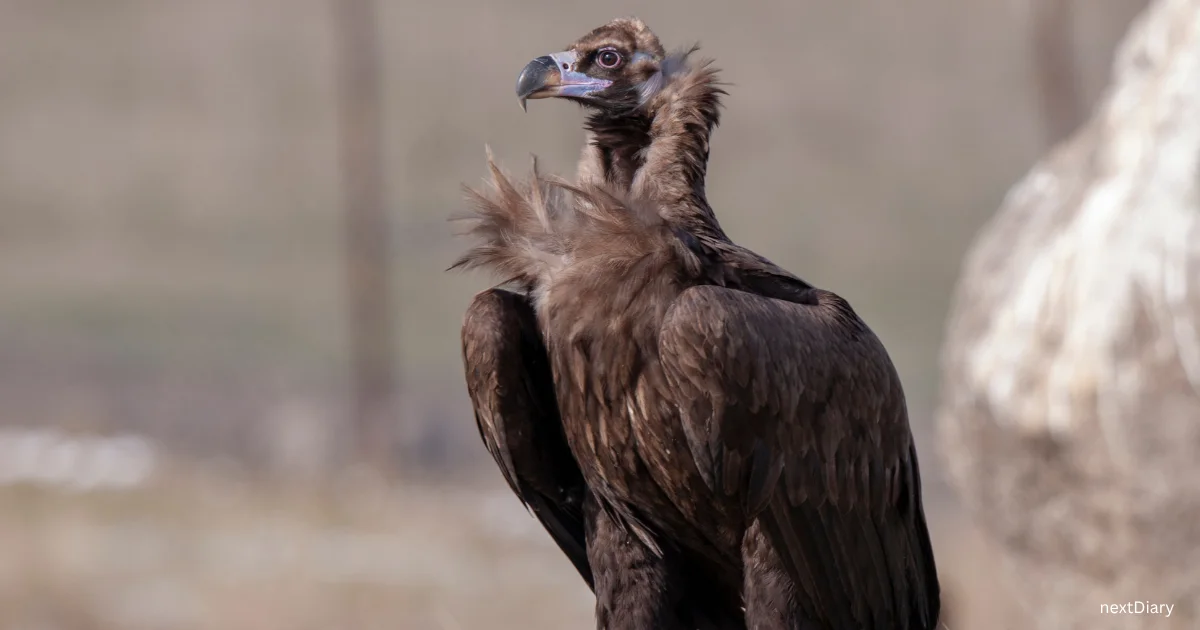

The recovery of a cinereous vulture in Madhya Pradesh has become a rare conservation success story, while exposing how fragile South Asia’s skies remain for scavenging birds.
On 4 May, somewhere over the dry country between Afghanistan and Uzbekistan, a satellite tag fixed to a cinereous vulture kept transmitting. Weeks earlier, the bird had been grounded in central India, injured and weak enough to be picked up by forest staff in Madhya Pradesh. Now it was 3,000km from its release site near Bhopal, heading back towards Central Asia under its own steam.
That journey has been presented, quite reasonably, as a conservation success. The bird was rescued in Vidisha district in December, treated at the Vulture Conservation Breeding Centre at Kerwa, near Bhopal, and released at Halali Dam in February. By early May it had crossed Rajasthan, Pakistan and Afghanistan before reaching Uzbekistan.
It is a stirring story, not least because vultures have had so few of them in South Asia over the past three decades. But the more interesting question is not whether one bird flew home. It is what that flight tells us about the state of the route beneath it: the carcass dumps, veterinary pharmacies, power lines and protected areas that now determine whether a migratory scavenger survives from one winter to the next.
A bird built for distance
Cinereous vultures, Aegypius monachus, are among the heaviest flying birds on Earth, broad-winged scavengers of mountains, steppe and open country. In Europe, some populations are largely resident. In Central Asia, they are more mobile, moving south when winter closes in and food becomes scarce.
Vibhu Prakash, former deputy director of the Bombay Natural History Society (BNHS) and one of India’s most experienced vulture biologists, has said the bird’s return movement is not unusual in itself. Cinereous vultures wintering in the subcontinent often head back towards breeding grounds in the Himalayas and Central Asia in spring. What is unusual is that this individual made the journey after being rescued, rehabilitated and released, and that conservationists were able to follow it.
The bird had been found in Sironj, in Vidisha district, in a weakened state on 19 December 2025. It was taken to the Kerwa centre, run jointly by Van Vihar National Park and BNHS, where staff stabilised and treated it before release on 23 February at Halali Dam in Raisen district.
For nearly a month it lingered in the area. Then, on 10 April, it left.
That detail matters. A released bird that simply survives a few days tells you one thing. A bird that regains condition, resumes migration and covers several thousand kilometres tells you rather more about the quality of the rehabilitation, and about the resilience of the species itself.
Why tagging changes the story
Without the GPS tag, this would have been a pleasant local rescue anecdote and little else. With it, the bird becomes data.
Telemetry, the use of satellite or GSM tags to track animals remotely, has transformed what conservationists know about vultures in South and Central Asia. It has shown that birds do not merely wander. They return to the same wintering grounds, use repeat corridors and depend on a network of places that may be separated by national borders but function, ecologically, as a single system.
That is one reason the Halali bird matters. It did not vanish into the sky as a rehabilitated success and become somebody else’s problem. It remained visible. Conservationists could see it move through Rajasthan, into Pakistan, across Afghanistan and on to Uzbekistan.
Krishna Prasad Bhusal, a Nepal-based conservation biologist affiliated with the Biodiversity Research Institute at the University of Oviedo and the IUCN Species Survival Commission’s Vulture Specialist Group, has argued that such tracking is changing how vultures are protected. The movements recorded from Nepal, India and Central Asia show that these are not incidental border crossings but routine parts of the birds’ ecology. In other words, the map used by a vulture bears little resemblance to the one used by a ministry.
There is a quiet rebuke in that fact. Conservation in South Asia is still organised largely by state and national boundaries. The birds, with customary indifference, ignore them.
India’s vulture problem is not history
That a cinereous vulture can be rescued and returned to the flyway is the hopeful part of the story. The less comfortable part is that the flyway remains dangerous.
India’s vultures suffered one of the fastest recorded population collapses of any bird group in modern times. White-rumped, Indian and slender-billed vultures fell by more than 95 per cent, with white-rumped vultures declining by about 99.9 per cent between the 1990s and the mid-2000s. The cause, eventually pinned down after years of detective work, was diclofenac, a veterinary anti-inflammatory drug used in livestock. Vultures feeding on treated carcasses died of kidney failure.
The drug was banned for veterinary use in India in 2006. That decision, driven in no small part by BNHS-led research and campaigning, remains one of the most important conservation interventions in modern India.
But bans are not forcefields.
BNHS and other conservation groups have repeatedly warned that diclofenac persisted in the system long after the ban, while other non-steroidal anti-inflammatory drugs, or NSAIDs, posed fresh risks. Conservationists have since pushed for safer alternatives such as meloxicam and tolfenamic acid, while also pressing for tighter control of drugs known to be toxic to vultures.
This matters for migratory species as much as for India’s resident vultures. A cinereous vulture wintering in Rajasthan or Madhya Pradesh may be less chronically exposed than a resident Gyps species that feeds year-round in the same landscapes. But one contaminated carcass can still be enough.
That risk is no abstraction. Earlier this year, a young cinereous vulture tagged in Kazakhstan was found dead in Rajasthan after completing previous migrations to the Indian subcontinent. Preliminary assessments suggested poisoning from veterinary drugs was a likely cause. One bird from Central Asia makes it back to Uzbekistan; another dies in India. Both stories belong to the same flyway.
Madhya Pradesh’s growing role
If there is a state that has started to grasp the scale of the challenge, it may be Madhya Pradesh.
The Vulture Conservation Breeding Centre at Kerwa was established in 2014 as a collaboration between the state forest department and BNHS. Its original focus was on two Critically Endangered Gyps vultures, white-rumped and Indian vultures, both devastated by diclofenac. More recently, the state has begun using the centre not only for captive breeding and rehabilitation, but also as a platform for rewilding and post-release monitoring.
That may sound procedural. It is not. Conservation breeding without safe release sites can become little more than a holding operation. Release without monitoring, meanwhile, can quickly descend into optimism untroubled by evidence.
The Halali bird suggests a more serious model. Rescue. Clinical treatment. quarantine. acclimatisation. Tagging. Release. Tracking. Then, crucially, using the results to understand where the dangers lie beyond the reserve boundary.
WWF-India has supported some of this tagging work, alongside BNHS and the Madhya Pradesh forest department. The point is not simply to celebrate long-distance movements. It is to identify the places where vultures stop, feed and die.
The politics of a carcass
Vulture conservation can appear oddly unglamorous. Tigers inspire posters; vultures send officials to inspect dead cattle.
Yet the whole story turns on carcasses and what is in them. A vulture-safe landscape is not merely one with cliffs, roost trees or thermals. It is one where livestock carcasses are free of toxic drugs, where poisoning is controlled, where dump sites are monitored, and where power infrastructure does not kill birds that have survived everything else.
India has responded to this in patches through what are known as Vulture Safe Zones, large landscapes around breeding colonies where conservationists work with veterinarians, livestock owners and pharmacies to reduce the availability of toxic NSAIDs. BNHS has been central to that effort.
The model is sensible because it accepts a basic truth: vultures do not live inside protected areas in the way that many conservation policies still assume. They feed in working landscapes, around villages, cattle camps, rubbish dumps and carcass sites. If conservation stops at the park gate, the birds do not.
The cinereous vulture from Halali Dam is a reminder of that, too. It did not fly from one reserve to another along a neat chain of protected land. It crossed a geopolitical tangle of farms, settlements, road corridors and power networks. Somewhere on that route, it had to find safe food often enough to keep going.
A success story, with an asterisk
There is no need to understate what has happened here. An injured vulture was rescued, rehabilitated and released, then completed a remarkable transboundary journey. In a region where vultures have been poisoned, persecuted and largely ignored, that is worth marking.
It also offers a useful correction to the fatalism that often shadows vulture conservation. Intervention can work. Birds can recover. Skilled veterinary care, patient husbandry and decent field science can return an animal to the sky.
But the satellite track also makes a promise it cannot itself keep. It shows where the bird went, not whether the route is becoming safe. For that, India and its neighbours will need more than rescue centres and celebratory press releases. They will need drug regulation that is enforced, not merely notified; cross-border cooperation that survives diplomatic weather; and a willingness to pay attention to a class of bird that does its best work when nobody is looking.
For now, one cinereous vulture has made it back to Uzbekistan. That is the good news.
The harder question is whether the next one will be able to do the same.