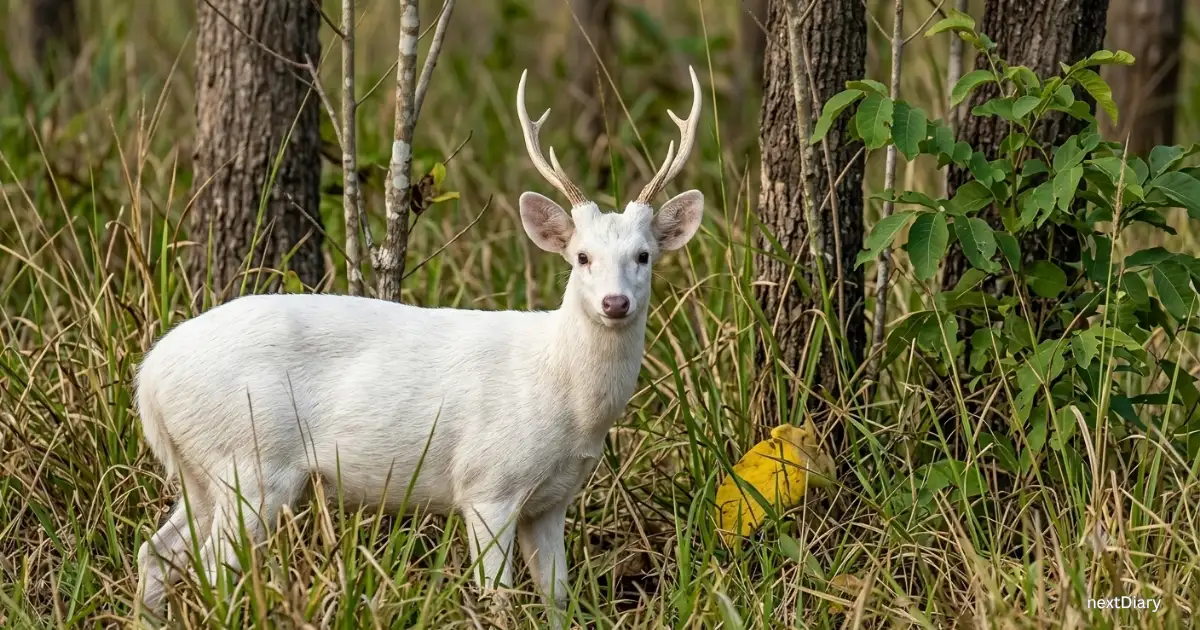

The pale deer filmed in Assam’s flagship national park has delighted wildlife watchers, but the sighting also throws fresh light on the fragile future of one of India’s most overlooked endangered mammals.
On 26 May, in the tall green grasslands of Kaziranga National Park, a deer the colour of bleached straw stepped into view. Its coat was so pale it seemed to glow against the floodplain. Within hours, a video shared by Assam chief minister Himanta Biswa Sarma had ricocheted across social media: an albino hog deer, small, low-slung and moving with the head-down gait that gives the species its name, threading through one of India’s most celebrated protected landscapes.
It was, on one level, exactly the sort of wildlife moment the internet adores. A rare animal. A famous park. A neat little symbol of wonder in a world that often feels short of it.
But albino animals are not simply curios. In the wild, they are often at a disadvantage from the moment they are born. And in the case of the hog deer, the sighting opens a larger and more interesting story: not just about an unusual white coat, but about the health of Assam’s floodplain grasslands, the fortunes of an endangered deer and the uneasy relationship between spectacle and conservation.
Why this deer matters
The hog deer, Axis porcinus, is one of those species that rarely gets top billing. It lacks the armour-plated charisma of Kaziranga’s greater one-horned rhinos and the political heft of its tigers. Yet it is a crucial animal in the park’s ecology: a grazer of alluvial grasslands and a prey species for large carnivores.
It is also in trouble across much of its range.
The species is listed as Endangered on the IUCN Red List, and protected under Schedule I of India’s Wild Life (Protection) Act, 1972, the country’s highest level of legal protection for wild animals. Across South and Southeast Asia, hog deer have been squeezed by grassland conversion, wetland drainage, poaching and the fragmentation of riverine habitat. Many surviving populations are now small and isolated.
Kaziranga is the great exception. The park and the wider Brahmaputra floodplain hold by far the strongest remaining population in India, which is precisely why an oddity spotted there deserves more than a passing nod.
“This is not just a nice photograph,” says Alolika Sinha, a wildlife biologist at the Assam-based conservation organisation Aaranyak, whose work has focused on hog deer ecology in the region. “Any unusual individual can become a doorway into a much bigger discussion about habitat quality, population security and how well we are monitoring a species that is still declining across much of its range.”
That is the point. The white deer is the hook. The real story is the grassland.
A genetic rarity, and a risky one
Albinism is caused by inherited mutations that disrupt the production of melanin, the pigment responsible for normal colour in skin, hair, fur and eyes. In mammals, truly albino individuals often show white or cream coats alongside pinkish eyes and pale hooves or skin.
The condition is rare in wild populations for a simple reason: it can be a poor survival strategy.
“Camouflage matters enormously in open habitats,” says Tejashree Joshi, head of environmental sustainability at Godrej Enterprises Group, who has commented publicly on the Kaziranga sighting. In floodplain grassland, she notes, a pale animal is likely to stand out to both predators and people. “Albinism can also come with visual problems and sensitivity to sunlight. So when you see an albino herbivore in the wild, you are looking at an individual that may be carrying several disadvantages at once.”
Kaziranga is no gentle refuge. It is a working floodplain, shaped by the Brahmaputra and by animals that kill for a living. Tigers patrol the elephant grass. Leopards move through woodland edges. Every monsoon rearranges the ground plan.
A normal hog deer is built for that world. It keeps low, dashes through cover and vanishes into tawny grass with remarkable efficiency. An albino hog deer, by contrast, is rather like turning up to a military exercise in a wedding suit.
That does not mean the deer is doomed. Plenty of animals survive despite disadvantages that, on paper, ought to finish them off. But it does explain why such sightings remain exceptional.
Kaziranga’s grasslands, not just its rhinos
Kaziranga is often described through its blockbuster species, which is understandable but incomplete. The park is one of the most important alluvial grassland ecosystems in Asia, a mosaic of tall elephant grass, wetlands, sandbars and riverine woodland spread across the floodplains of the Brahmaputra.
That habitat supports far more than rhinos. In recent years, the park has also been highlighting its lesser-known fauna, including grassland birds and smaller carnivores. In 2025, Kaziranga’s first grassland bird survey recorded 43 species associated with these habitats, among them globally threatened birds that depend on precisely the same floodplain system that sustains hog deer.
The park’s director, Sonali Ghosh, has repeatedly pushed that wider message: Kaziranga is not merely a rhino stronghold, but a functioning floodplain ecosystem. That matters because floodplain grasslands are among the most threatened habitats in the subcontinent. They are productive, accessible and therefore perpetually tempting for drainage, cultivation, roads and tourism infrastructure.
For hog deer, habitat quality is everything. The species favours dense grassland near water, often in the sort of low-lying riverine country that humans are very good at converting. When that cover is lost or broken up, deer become more exposed to hunting, dogs and disturbance. Small populations then become vulnerable to the usual spiral of isolation, low genetic exchange and local decline.
A 2018 study in Scientific Reports, led by researchers including Sandeep Kumar Gupta and Syed Ainul Hussain, underscored the conservation importance of India’s remaining hog deer populations and the need to manage them carefully as distinct evolutionary units. In plain English: these are not deer populations you can afford to treat as interchangeable.
The problem with viral wildlife
There is, of course, another side to all this. Rare animals bring attention. Attention can bring tourists. Tourists bring money, and money, if channelled properly, can support conservation and local livelihoods.
No park manager is likely to complain about people taking an interest in a hog deer.
Yet wildlife virality is a fickle business. A white deer goes viral because it is unusual, not because the public has suddenly developed a deep concern for floodplain management or cervid genetics. The danger is that conservation gets reduced to a parade of novelties: the golden tiger, the white deer, the oddity of the month.
Kaziranga knows this better than most. The park has become something of a magnet for stories about unusual colour morphs, most notably the so-called golden tigers that have drawn global attention. Such sightings are fascinating, but they can distort the picture if they become the story.
The harder, less photogenic work lies elsewhere: maintaining habitat mosaics after annual flooding, controlling invasive plants, securing corridors to the Karbi Anglong hills, reducing disturbance and keeping poaching pressure low. It lies, too, in long-term monitoring. If a rare albino deer has appeared, was it a one-off event, or is there a cluster of related individuals in a local population? Is the sighting simply a genetic fluke, or does it tell us something about how isolated certain herds may be?
Those are not questions social media can answer.
What happens next
The sensible response to the sighting is neither to sentimentalise it nor to shrug it off. It is to treat it as a useful prompt.
For researchers, that means documenting the animal carefully, recording where it was seen, and folding the observation into broader monitoring of hog deer in Kaziranga’s ranges. For park managers, it is a chance to remind the public that this is an endangered species first and an internet sensation second. For the rest of us, it is a nudge to pay attention to the animals that live in the shadow of rhinos and tigers.
Hog deer have long suffered from that shadow. They are abundant enough in Kaziranga to be overlooked, but scarce enough elsewhere to be in genuine peril. That is an awkward conservation position. It invites complacency in the very place where the species still thrives.
A white deer crossing a green Assamese floodplain will not change that on its own. It may not survive long enough even to become more than a brief footnote in Kaziranga’s long natural history. But it has, for a moment, forced an endangered deer into the frame.
The question is whether anyone keeps looking once the novelty fades.