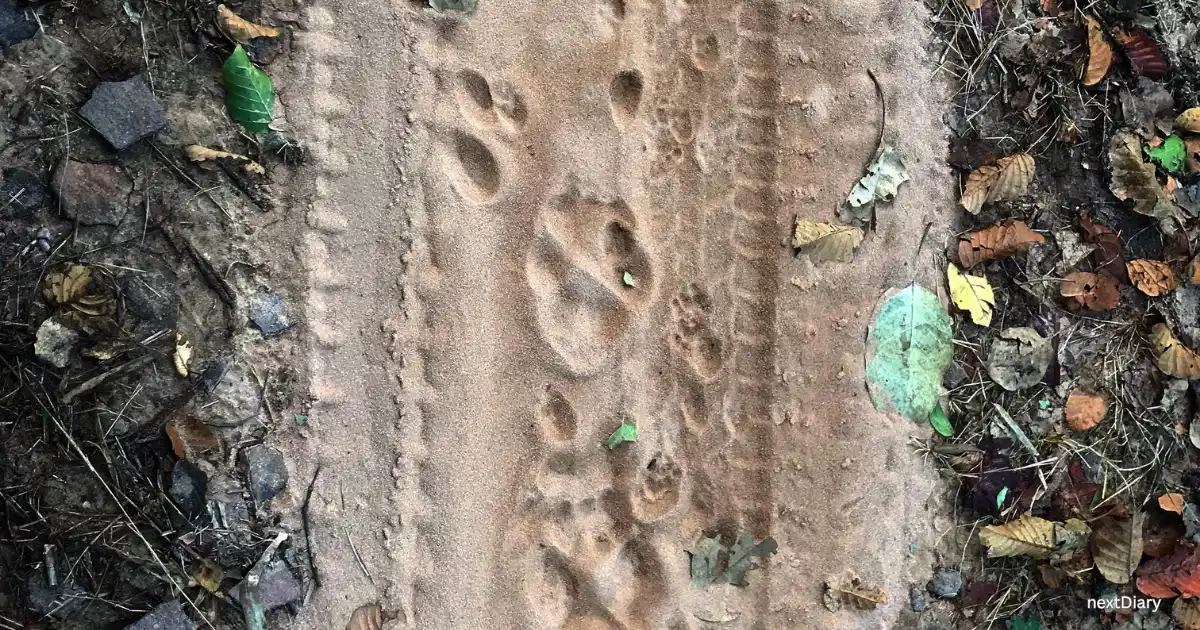

Forest officers believe tigers still roam Uttar Pradesh’s Sohagi Barwa Wildlife Sanctuary, but distinguishing their tracks from those of leopards has become an unexpectedly significant conservation challenge.
A line of paw prints pressed into damp forest soil has become the focus of an unusually high-stakes investigation in eastern Uttar Pradesh. Deep inside Sohagi Barwa Wildlife Sanctuary, close to India’s border with Nepal, forest staff completing the latest tiger census have found themselves confronting an awkward question: do the tracks belong to a tiger, or a leopard? Until they know the answer, the sanctuary’s official tiger population remains uncertain.
The survey has produced encouraging signs that the reserve supports around four tigers, according to preliminary assessments by the Uttar Pradesh Forest Department. Yet those numbers remain provisional. Several sets of pugmarks proved difficult to identify with confidence, prompting officials to seek an independent assessment from specialists at the Wildlife Institute of India (WII).
It is an unusual reminder that, despite the growing sophistication of wildlife monitoring, conservation still depends upon careful fieldcraft. A single misidentified footprint can influence how an entire landscape is managed.
Why a footprint matters
For many visitors, a tiger’s pugmark appears unmistakable. In practice, identifying large cat tracks is rarely so straightforward.
Rain softens edges. Dry leaves distort impressions. Animals step on uneven ground. Leopard tracks, particularly those of large males, can overlap in size with smaller tigers. Partial prints only complicate matters further.
Experienced trackers examine more than width or length. They study the shape of the heel pad, the spacing between toes, stride length and the animal’s gait across a sequence of prints. Even then, certainty is not always possible.
That uncertainty explains why the Wildlife Institute of India has been asked to examine the evidence before officials publish a final census figure.
Scientists at WII have helped develop many of India’s modern carnivore monitoring techniques and routinely support state forest departments with complex identifications. Their assessment will determine whether the disputed tracks belong to tigers, leopards or perhaps multiple individuals using the same route.
Beyond counting cats
Tiger numbers are not merely a point of curiosity. They shape conservation policy, funding priorities and anti-poaching operations.
Under India’s National Tiger Conservation Authority (NTCA), tiger-bearing landscapes receive additional scientific attention and management support. Reliable population estimates also contribute to the country’s wider commitment under the Global Biodiversity Framework, agreed at the United Nations Convention on Biological Diversity in 2022, which calls for halting and reversing biodiversity loss by 2030.
An inflated estimate risks directing scarce resources inefficiently.
An underestimated population may leave an important breeding landscape without the protection it requires.
Neither outcome serves wildlife well.
A forest between landscapes
Sohagi Barwa Wildlife Sanctuary occupies an important ecological position along the Terai Arc Landscape, one of South Asia’s most significant conservation corridors.
Stretching across northern India and southern Nepal, the Terai Arc links protected forests that allow wide-ranging mammals including tigers, elephants and leopards to disperse between populations.
Connectivity has become increasingly important as tiger numbers recover across parts of India.
The country’s most recent national assessment estimated 3,682 wild tigers, representing roughly three quarters of the global population. That success has shifted attention from simply protecting isolated reserves towards maintaining safe movement between them.
Smaller sanctuaries such as Sohagi Barwa may therefore perform a role far greater than their size suggests.
A handful of resident tigers can strengthen genetic exchange across the wider landscape.
Technology has limits
India’s tiger monitoring has become increasingly sophisticated over the past two decades.
Camera traps now identify individual animals through their unique stripe patterns. Genetic analysis from scat can confirm species and even family relationships. Satellite mapping helps researchers understand habitat use with remarkable precision.
Yet none of these technologies eliminates the need for experienced people on the ground.
Camera traps cannot monitor every metre of forest.
DNA samples are not always available.
Field signs remain essential, particularly in dense woodland where animals rarely present themselves to cameras.
This is where experienced trackers continue to provide irreplaceable knowledge. Their observations often determine where cameras are placed and which areas deserve closer investigation.
The disputed tracks at Sohagi Barwa demonstrate that conservation still relies upon both technology and human judgement.
What happens next?
Forest officials now await WII’s expert assessment before announcing the sanctuary’s confirmed tiger population.
If the tracks prove genuine, Sohagi Barwa could strengthen its position as another important node within India’s recovering tiger network.
If they belong instead to leopards, the outcome remains valuable. Leopards are themselves highly adaptable apex predators whose presence indicates functioning forest ecosystems, even if their conservation challenges differ from those facing tigers.
Either way, the exercise underlines an often overlooked truth about wildlife science.
The hardest part is not always finding the animal.
Sometimes it is interpreting the evidence the animal leaves behind.
As India’s tiger recovery continues to attract global attention, every footprint carries weight. Not because it guarantees another tiger, but because conservation decisions increasingly depend on getting even the smallest details right. The final verdict from the Wildlife Institute of India will settle more than a question of identification. It will help determine how one overlooked stretch of forest fits into the future of tiger conservation across the Terai.