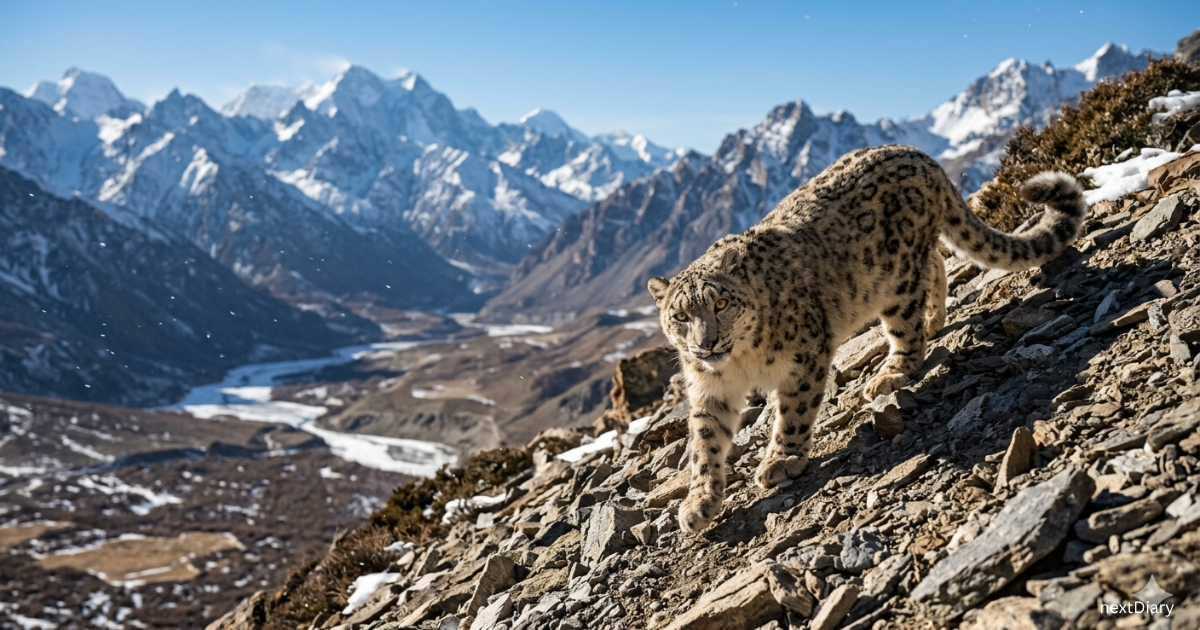

The Himalayan region’s newly approved conservation society aims to safeguard snow leopards, fragile mountain ecosystems and the communities that share them.
On a windswept plateau more than 4,000 metres above sea level, where blue sheep pick their way across scree slopes and the air carries little but dust and silence, Ladakh’s administration has taken an unusual step. It has created an institution dedicated not only to a species, but to an entire landscape.
Earlier this month, the Union Territory approved the formation of the Snow Leopard and High-Altitude Nature Conservation Society, known as SHAN. The move may sound bureaucratic. In practice, it represents one of India’s most ambitious attempts to protect a mountain ecosystem that is increasingly squeezed between climate change, infrastructure development and the demands of a growing tourism economy.
The decision carries particular weight because Ladakh is the global stronghold of one of the world’s most elusive big cats.
According to India’s first nationwide Snow Leopard Population Assessment, released in 2024, the country supports an estimated 718 snow leopards. Of those, 477 were recorded in Ladakh. In other words, roughly two-thirds of India’s snow leopards roam this cold desert landscape.
For conservationists, the numbers underline an obvious reality. If snow leopards are to thrive in India, Ladakh must remain healthy.
Why create a new conservation body?
The newly established SHAN society will oversee conservation efforts across Ladakh’s high-altitude ecosystems. Its remit extends well beyond snow leopards.
The organisation is expected to coordinate research, habitat management, wildlife monitoring, wetland protection, conflict mitigation and community-led conservation projects. It will also support sustainable livelihood programmes and responsible nature tourism.
That broad mandate reflects a growing shift in conservation thinking.
“Snow leopards are an umbrella species,” explains Sejal Worah, Programme Director at WWF-India and a member of the society’s governing body. Protecting them, she says, means protecting prey species, mountain grasslands, alpine wetlands and the ecological processes that sustain life across the Trans-Himalaya.
The phrase “umbrella species” can sound technical. In simple terms, conserving a snow leopard’s vast territory safeguards countless other species that occupy the same landscape.
That matters in a region where ecological relationships remain finely balanced.
The science behind the decision
Snow leopards sit at the top of the food chain across the Himalaya and Karakoram ranges. Their presence indicates healthy populations of prey such as Himalayan ibex and bharal, also known as blue sheep.
When predator numbers decline, scientists often find wider ecosystem disruption close behind.
The Snow Leopard Population Assessment of India, known as SPAI, covered around 120,000 square kilometres of potential habitat. Researchers deployed camera traps, surveyed tracks and signs, and used advanced occupancy modelling to estimate population size.
The study provided the most detailed picture yet of the species’ status in India.
For years, conservationists suspected Ladakh held the country’s largest snow leopard population. The assessment finally put a figure on that assumption.
It also reinforced the region’s global significance.
Snow leopards range across 12 countries, from Mongolia to Bhutan, yet remain notoriously difficult to monitor. Their remote habitat and low population density make them among the least observed of the world’s big cats.
Conservation and communities
One notable aspect of SHAN is its emphasis on local participation.
The governing body includes government officials, scientists, conservation practitioners, representatives from monasteries, women’s groups and community organisations.
That mix is deliberate.
For decades, conservationists have learned that protecting snow leopards depends as much on people as predators.
When snow leopards kill livestock, the financial impact on mountain families can be severe. A single lost yak or goat may represent months of income.
Conservation groups operating in Ladakh have increasingly focused on insurance schemes, predator-proof corrals and wildlife tourism initiatives that generate alternative revenue.
Among the best-known examples is Tar village, which recently gained recognition as Ladakh’s first Community Conserved Area. Residents there have embraced conservation-linked tourism, creating economic incentives to protect wildlife that was once viewed primarily as a threat.
Sandesh Kadur, the National Geographic Explorer and wildlife filmmaker who also sits on the society’s governing body, has spent years documenting these landscapes.
The success of conservation in Ladakh, he argues, depends on maintaining local support. Wildlife survives because communities choose to tolerate it.
A changing mountain world
The creation of SHAN arrives at a moment of rapid change across the Himalaya.
Road construction, military infrastructure, tourism growth and climate change are reshaping high-altitude environments at unprecedented speed.
Scientists have documented shifting snowfall patterns, retreating glaciers and changes in vegetation across parts of the Trans-Himalayan region.
These trends affect wildlife directly.
Snow leopards depend on large, connected landscapes. Fragmented habitats can isolate populations and reduce genetic exchange.
Meanwhile, warming temperatures may alter the distribution of prey species and increase competition with livestock grazing.
The challenge is not unique to India.
Several snow leopard range countries participate in the Global Snow Leopard and Ecosystem Protection Programme, an international initiative launched in 2013 to secure key habitats across Central and South Asia.
SHAN appears designed to translate some of those broader conservation ambitions into practical action on the ground.
What happens next?
Creating a conservation institution is easier than funding one.
The real test for SHAN will come over the next few years as it attempts to coordinate research, community engagement and habitat protection across one of the world’s harshest environments.
Its supporters point to Ladakh’s strong conservation record and growing public interest in wildlife tourism.
Critics may ask whether another administrative body can deliver meaningful change in landscapes facing increasingly complex pressures.
For now, the society represents a rare acknowledgement that species conservation cannot be separated from ecosystem conservation.
The snow leopard may be its emblem. The task is much larger.
Across Ladakh’s vast mountains, where a glimpse of a snow leopard remains one of wildlife’s great privileges, the future of the cat will depend on decisions made far beyond the ridgelines it inhabits. Whether SHAN can turn ambition into lasting protection remains an open question