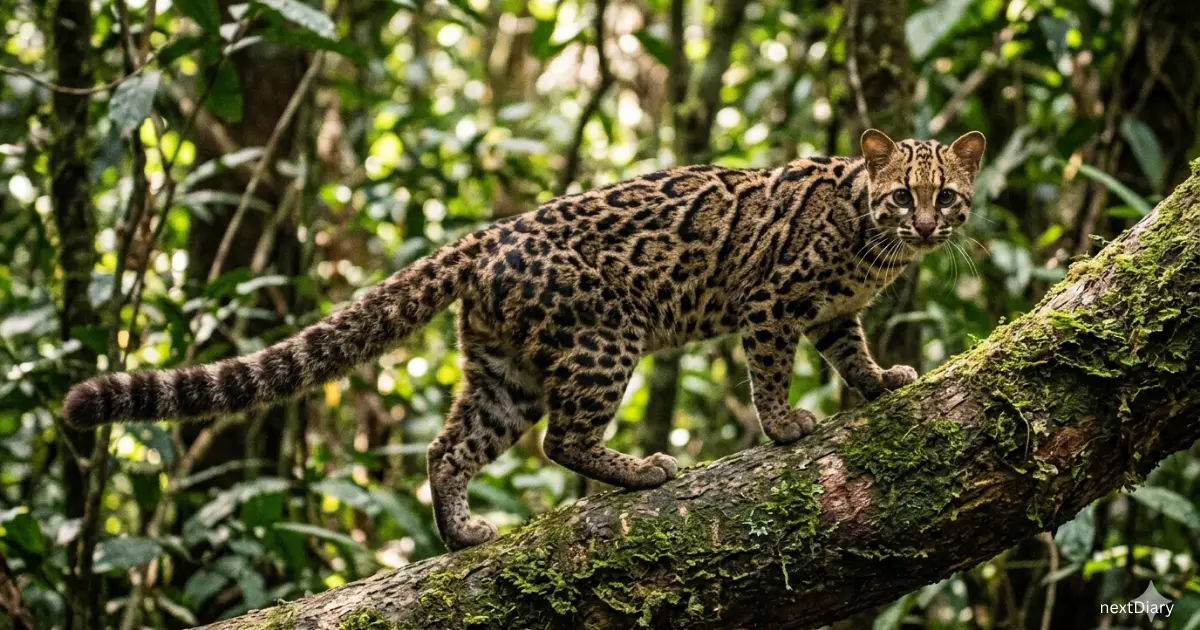

One of Asia’s least-studied wild cats is finding protection not inside national parks, but in community forests where local people are choosing conservation over hunting.
On 1 March this year, villagers gathered beneath the forested ridges of Arunachal Pradesh and Nagaland to celebrate the first International Marbled Cat Day. Banners hung between bamboo poles. Schoolchildren painted images of a cat many had never seen. For conservationists, that was precisely the point. The marbled cat remains so elusive that even people living within its range often know little about it.
Few wild cats are as mysterious.
Roughly the size of a domestic cat, but cloaked in cloud-like markings that resemble those of a miniature clouded leopard, the marbled cat (Pardofelis marmorata) inhabits dense forests stretching from the eastern Himalayas to Southeast Asia. Despite occupying a vast range, scientists still know remarkably little about its ecology.
Most records come from camera traps rather than direct observation.
That lack of knowledge has become a conservation problem in its own right.
“If people don’t know about a species, it’s difficult to build conservation around it,” says Giridhar Malla, founder of the Eastern Himalayas Marbled Cat Project (EHMCP), who has spent years documenting the cat across northeast India.
Malla knows how difficult that task can be. One of his most memorable records came from a camera trap in Arunachal Pradesh that captured a marbled cat scent-marking a tree trunk. The image lasted seconds. Obtaining it took months.
A cat living beyond the fence
The conservation story emerging around the marbled cat differs from that of tigers or rhinos.
Many of the forests supporting the species lie outside protected areas.
Camera-trap surveys conducted by EHMCP between 2022 and 2025 documented marbled cats across Arunachal Pradesh, Nagaland and Meghalaya. The findings reinforced a growing concern among researchers: substantial portions of the species’ habitat fall within community-managed forests rather than wildlife sanctuaries or national parks.
That reality shifts responsibility.
In October 2025, residents of Lokpeng village in Arunachal Pradesh declared Hii Hii Community Forest India’s first community-conserved area dedicated specifically to the marbled cat. Nearby communities introduced hunting restrictions and expanded wildlife monitoring efforts.
For a species that rarely features in government conservation campaigns, local decisions may prove decisive.
“We soon realised that most wild felid habitats extend beyond protected areas,” says Malla. “If conservation efforts are to be effective, we need to focus on sensitising communities living around these forests.”
Why scientists are worried
The marbled cat is currently classified as Near Threatened on the International Union for Conservation of Nature (IUCN) Red List.
That designation reflects mounting concern about habitat loss across its range.
Research published in Ecosphere found the species strongly associated with intact forest cover and relatively sensitive to human disturbance. Unlike some adaptable carnivores, marbled cats appear reluctant to occupy fragmented landscapes.
In practical terms, that means roads, infrastructure projects and forest conversion can isolate populations.
The concern extends well beyond India.
Across Southeast Asia, researchers estimate that more than half of suitable forest habitat for the species has experienced varying degrees of degradation. Yet only a modest proportion of the cat’s range falls within formally protected areas.
Conservationists increasingly view community forests as a critical buffer.
Turning hunters into conservationists
In Hebamlo village, Nagaland, residents recently adopted resolutions restricting the hunting of small wild cats.
The shift did not happen overnight.
Many conservation projects struggle because they treat local communities as obstacles rather than partners. The marbled cat initiative has taken a different approach.
Former hunters now assist camera-trap surveys. Young villagers help researchers retrieve memory cards and identify wildlife images. School outreach programmes explain why small carnivores matter within forest ecosystems.
Yomli Mayi, a field researcher working with communities in Arunachal Pradesh, remembers interviewing an elderly villager about changes in local wildlife.
“She told me the forests used to be denser and wildlife sightings were more frequent,” Mayi says. The observation was anecdotal, but it echoed concerns emerging from scientific surveys.
Such local knowledge often provides historical context unavailable in published research.
The funding challenge facing small cats
Conservation funding tends to follow celebrity.
Tigers attract headlines. Elephants command international campaigns. Smaller felids rarely receive comparable attention.
Jimmy Borah, Deputy Director of the Legal and Advocacy Division at Aaranyak, believes this imbalance helps explain why marbled cats remain poorly studied.
“The lack of sufficient studies on the marbled cat largely comes down to funding,” he says.
Borah argues that researchers frequently encounter the species during broader carnivore surveys, but dedicated studies remain rare.
The result is a familiar conservation paradox.
Scientists know enough to recognise a potential problem. They do not yet know enough to quantify it fully.
Can ecotourism help?
Some communities hope wildlife tourism could provide part of the answer.
Several villages in the Siang landscape are exploring community-run homestays and wildlife tourism initiatives. The aim is not to showcase marbled cats directly. The chances of seeing one remain vanishingly small.
Instead, communities hope the cat can become a symbol of healthy forests that support a wider suite of wildlife, including clouded leopards, Asiatic golden cats and Himalayan black bears.
The approach mirrors conservation models increasingly used across Asia and supported under international frameworks such as REDD+ (Reducing Emissions from Deforestation and Forest Degradation), which seeks to align forest protection with economic incentives.
Borah supports carefully managed tourism but warns against overdevelopment.
“Low-impact, community-led ecotourism can contribute positively to conservation,” he says. Large infrastructure projects, however, can undermine the very habitats they seek to promote.
A test case for community conservation
India supports around 15 species of wild cat, one of the highest totals anywhere in the world.
Most conservation attention, understandably, focuses on tigers.
Yet the marbled cat raises an uncomfortable question. What happens to species that are neither abundant enough to ignore nor charismatic enough to attract substantial funding?
The answer may emerge from the community forests of northeast India.
As dusk settles across the hills of Arunachal Pradesh, camera traps continue their silent work beneath dense canopies. Somewhere above them, a marbled cat may be moving through the branches, unseen.
Researchers are still trying to determine how many remain. Communities are still deciding how much protection they can provide. Development pressures continue to advance across the landscape.
For now, those three stories are unfolding together. It remains unclear which one will ultimately define the future of one of Asia’s most elusive cats.