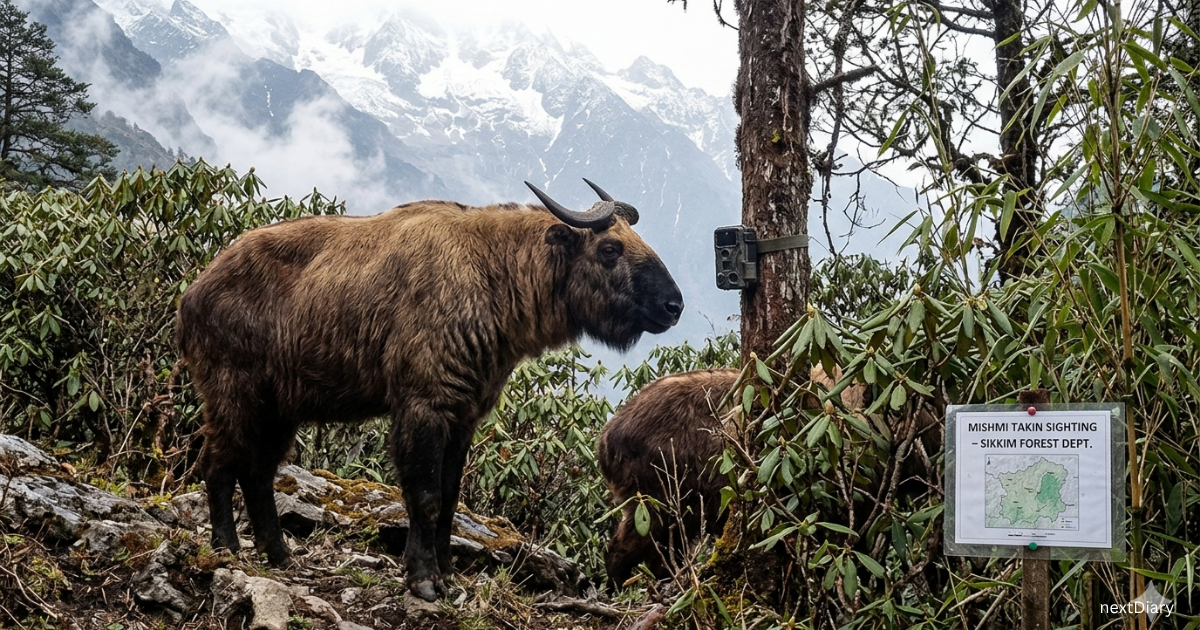

The first video record of Mishmi takins in Sikkim for nearly three decades is more than a wildlife curiosity. It may be evidence that one of the eastern Himalaya’s least-studied large mammals is still moving through a fragmented mountain landscape.
On 14 June, during a routine patrol in Bakuchaang under North Sikkim’s Tingda Reserve Forest, forest staff stopped long enough to film eight dark, shaggy bodies moving across a steep Himalayan slope. The animals were Mishmi takins, among the most elusive large mammals in India. The footage is the first video record of the species from the area and, in Sikkim, the first confirmed documentation in 27 years.
For Sikkim’s forest department, the moment was plainly significant. The herd of eight is the largest group of takins yet recorded from that locality. For conservation biologists, however, the real interest lies beyond the clip itself. A takin is not merely a handsome oddity with the front end of a musk ox and the hindquarters of a goat. It is a wide-ranging mountain herbivore that needs room, quiet and, above all, connected habitat.
That is why this sighting matters.
Why one video matters so much
The Mishmi takin, Budorcas taxicolor taxicolor, is a high-altitude caprid found across parts of north-east India, Bhutan, Myanmar and south-west China. It is listed as Vulnerable on the IUCN Red List and appears in Appendix II of CITES, the Convention on International Trade in Endangered Species, which regulates international trade in wildlife. In India it is also protected under Schedule I of the Wild Life (Protection) Act, the country’s highest tier of legal protection.
That formal protection tells only part of the story. Takins remain poorly studied because they live where fieldwork is difficult: wet, steep, forested slopes and alpine scrub between roughly 1,000 and 4,500 metres. They are built for this life, with a dense oily coat that sheds rain and snow, and a broad muzzle suited to browsing bamboo, willow and other upland vegetation. They are also conspicuously under-documented. There are no reliable population estimates for the Mishmi takin in India, which makes each verified record disproportionately important.
The last documented record in Sikkim dates to June 1999, when the species was photographed in east Sikkim and later written up by the conservationist Usha Ganguli-Lachungpa in the Journal of the Bombay Natural History Society. The coincidence is irresistible: the new video was captured on 14 June 2026, almost exactly 27 years after that earlier photographic record on 16 June 1999.
A herd at Bakuchaang, and a larger landscape behind it
It would be easy to present the Tingda sighting as a simple story of rediscovery. It is not quite that. Takins had not necessarily vanished from Sikkim. Rather, they had slipped from the record, which is a different thing entirely in mountain landscapes where survey effort is sparse and weather can swallow weeks of fieldwork whole.
Avantika Thapa, a postdoctoral research associate at the Ashoka Trust for Research in Ecology and the Environment, put the finding in its wider geographical context when speaking to NDTV. Tingda Reserve Forest, she noted, sits beside the Kyongnosla Alpine Wildlife Sanctuary and forms part of a broader transboundary protected network running through Pangolakha Wildlife Sanctuary towards Bhutan’s Jigme Khesar Strict Nature Reserve, where takins occur more regularly. In other words, the herd filmed in Sikkim may not be an isolated pocket at all. It may be using a larger Himalayan corridor.
That possibility changes the meaning of the sighting. A single record can confirm presence. Repeated records, spread across adjoining forests, can begin to reveal movement. For a species like the takin, which is likely to track food, weather and seasonal conditions across altitude, that distinction matters. Conservationists are not simply asking, “Is the animal still here?” They are asking whether it can still move.
Fragmented mountains are bad news for wide-ranging herbivores
Pujan Pradhan, a researcher associated with the Wildlife Institute of India who studies endangered Himalayan mammals, was more direct. Sikkim, he told NDTV, has undergone substantial landscape modification in recent decades, driven by rising anthropogenic pressure and the fragmentation that follows it. For a large herbivore, fragmentation can be a slow violence. Roads split forest blocks. Hydropower schemes and associated infrastructure push disturbance into valleys. Grazing pressure and expanding settlements alter vegetation and bring livestock, dogs and people deeper into wildlife habitat.
This is not unique to takins, of course. Fragmentation has become the defining conservation problem across much of the Himalaya, where the map of “protected areas” often looks reassuring until one examines what lies between them. A sanctuary boundary may be legally sound on paper, yet ecologically flimsy if the ridges and valleys linking it to neighbouring habitat are severed by traffic, fencing, quarrying or repeated human disturbance.
Takins are useful in this regard because they are awkwardly demanding animals. They are large. They browse heavily. They need access to seasonal forage and shelter. If they are still moving through the Tingda-Kyongnosla-Pangolakha landscape, then that says something potentially encouraging about the integrity of the habitat. It also raises an awkward question for planners: how much more fragmentation can that landscape absorb before movement stops?
The science gap is part of the problem
One reason the takin slips so easily into the margins of conservation debate is that it lacks the celebrity of the snow leopard or red panda. It is neither a flagship species in the modern fundraising sense nor an animal most people, even in India, could identify. That obscurity has consequences.
The takin has been on conservation radars for decades, yet the basic evidence base remains thin. The IUCN notes that population data are limited. Older caprine action plans flagged overhunting, habitat loss and disturbance as key threats, while also calling for more ecological study. More recently, work on takin taxonomy and genomics has underlined how much remains unresolved about variation within the species complex, local adaptation and conservation priorities across its range.
None of that means Sikkim’s takins are in immediate peril. It means something subtler and, in its own way, more troublesome: the species is hard to manage well because the evidence base is patchy. Conservation can only be as precise as the information underpinning it. For an animal that appears sporadically, in terrain that punishes field biologists, “under-studied” is not a throwaway line. It is the central management problem.
What happens next
The obvious next step is not another round of congratulatory social media posts, though the excitement is understandable. It is systematic survey work. Camera traps placed along likely movement routes would help establish whether the Bakuchaang herd was resident, transient or part of a larger population spread across the connected landscape. Genetic sampling from dung could clarify whether Sikkim’s animals are isolated or exchanging individuals with populations across the border. Habitat-use studies could identify which ridgelines, bamboo patches and forest corridors matter most, and therefore which places need the strongest protection from future development.
There is a policy point here too. India has become more sophisticated at discussing connectivity for tigers and elephants, species that draw money and ministerial attention. The same thinking needs to reach the eastern Himalaya’s lesser-known herbivores. A corridor is not only for predators. It is for prey, browsers, pollinators and everything else that has to move through a changing landscape to survive.
The Tingda footage gives Sikkim an opportunity to do something conservation rarely does gracefully: act before a species disappears from view again.
For now, what we have is eight takins on a slope, filmed by alert forest staff in a reserve forest most people could not place on a map. That is enough for a good headline. It may also be the start of a more interesting question, and a more difficult one. In a Himalayan landscape increasingly carved up by roads, power projects and the tidy language of development, was this herd simply spotted at the right moment, or has it revealed that one of the region’s old wildlife routes is still just about holding?