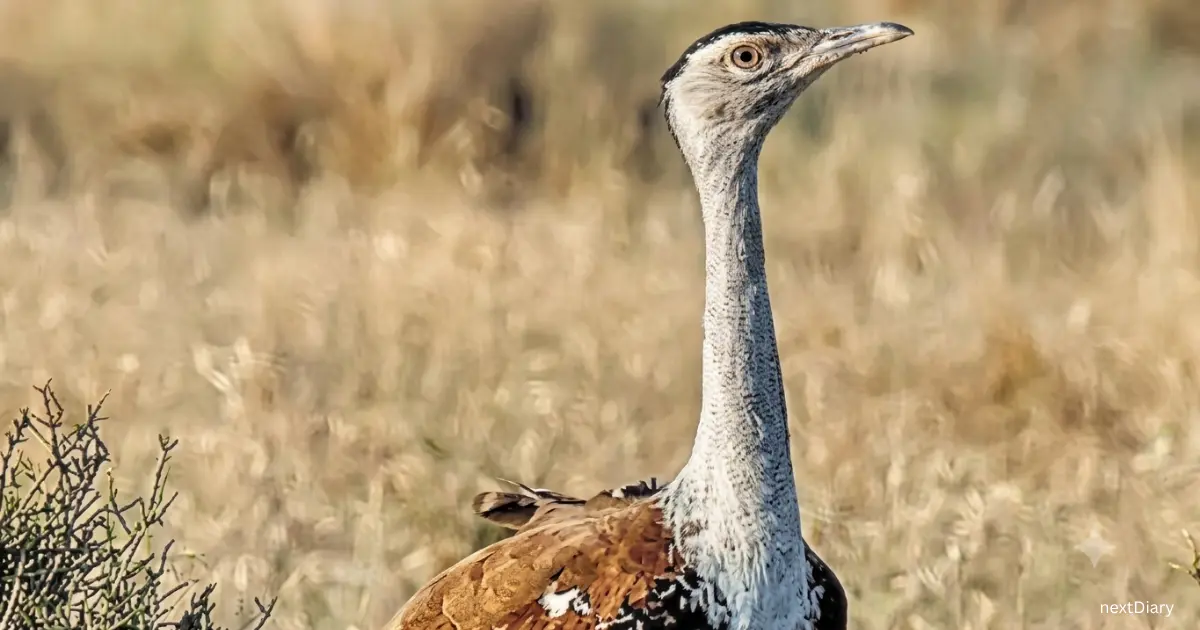

Three decades after the great Indian bustard disappeared from Madhya Pradesh, officials are again talking of return. The question is whether India has fixed the reasons it vanished in the first place.
The great Indian bustard has been gone from Madhya Pradesh for so long that its return now risks sounding like folklore. Yet this week, state officials said they are preparing to bring the bird back, reviving plans to reintroduce one of India’s rarest and most imperilled species to Ghatigaon Wildlife Sanctuary, near Gwalior, a reserve created for it in 1981.
The bird is known locally as son chiriya, the golden bird. It is also one of the most awkward tests Indian conservation has set itself in recent years. Not because nobody knows what the bustard needs. In truth, the species has been studied for decades. It needs large, open grasslands, low disturbance, very little tall infrastructure and a good deal less official optimism than it usually receives.
What Madhya Pradesh is proposing is, on paper, simple enough: take birds, or more likely eggs or captive-bred young, from Rajasthan’s recovery programme and establish a new population in the state where bustards once bred. In practice, it amounts to asking whether India can reassemble a vanished grassland bird in a landscape that helped erase it.
A bird that outlived the plan made to save it
Ghatigaon, west of Gwalior, was notified as a sanctuary specifically for the great Indian bustard. So was Karera, in neighbouring Shivpuri district. Both once held the species. Both then became case studies in how to lose it.
By the early 2010s, officials were already admitting that bustards had effectively disappeared from Madhya Pradesh. Agricultural expansion, encroachment, mining, poaching and the slow attrition of grassland habitat all took their toll. Conservationists have long argued that the sanctuaries were poorly matched to the bird’s needs and even more poorly defended from competing land uses.
That matters, because the state is not attempting a reintroduction into empty country. It is attempting one in a place with a conservation history, and not an especially flattering one.
“The bustard is a grassland specialist, but in India grasslands are still treated as if they are waiting rooms for some other land use,” says Kedar Gore, director of The Corbett Foundation and a member of the International Union for Conservation of Nature’s Bustard Specialist Group. That bureaucratic habit, he says, has done almost as much damage as poaching. “If the habitat is not secured at scale, reintroduction becomes a gesture rather than recovery.”
He is in a position to know. Gore has tracked bustard conservation across multiple states and has repeatedly warned that release sites need more than fencing and good intentions. They need connected habitat, minimal hostile infrastructure and long-term protection that survives the next administrative reshuffle.
Rajasthan’s breeding programme has changed the arithmetic
If Madhya Pradesh is talking seriously about bustards again, it is because Rajasthan has, at last, produced something to work with.
At the conservation breeding centres at Ramdevra and Sudasari in Jaisalmer district, the captive population has grown steadily under Project Great Indian Bustard, a joint effort involving the Rajasthan forest department, the Ministry of Environment, Forest and Climate Change and the Wildlife Institute of India. This year the programme passed another milestone, with the captive population rising to more than 70 birds after fresh hatchings, including chicks produced through artificial insemination.
That number needs context. Fewer than 150 great Indian bustards are thought to survive in the wild in India, with the overwhelming majority in Rajasthan and tiny remnants in a handful of other states. In other words, the captive flock is no side note. It is rapidly becoming the species’ insurance policy.
Sujit Narwade, a scientist with the Wildlife Institute of India who has worked on bustard recovery planning, has described captive breeding as a necessary bridge rather than a solution in itself. The point is not to fill aviaries with rare birds. It is to create enough genetically managed individuals to release back into secure landscapes before the wild population slips beyond rescue.
That bridge is now beginning to extend beyond Rajasthan. Under the next phase of the national bustard recovery programme, scientists plan soft releases of captive-bred birds and wider surveys across former range states, including Madhya Pradesh, Maharashtra, Gujarat, Karnataka and Andhra Pradesh.
Which makes the MP plan understandable. The state can see a source population taking shape. It wants in.
But the bustard’s real enemy is still standing on pylons
The awkward part is that India’s bustard crisis was never simply about bird numbers. It is about the landscape into which those birds must fly.
The great Indian bustard is one of the heaviest flying birds on Earth, a tall, long-legged denizen of open country with poor frontal vision. That unfortunate combination makes it especially vulnerable to overhead power lines. In Rajasthan, collisions with transmission lines have become one of the most serious immediate threats to the species. Scientists and campaigners have been warning for years that even a handful of such deaths is intolerable when the entire wild population is so small.
The legal fight over those wires has become one of India’s most consequential wildlife cases. In 2021, the Supreme Court ordered overhead power lines to be buried underground in priority bustard habitat in Rajasthan and Gujarat where feasible. In 2024 and 2025, the court and an expert committee revisited the issue, trying to reconcile bustard conservation with India’s expanding renewable energy network. By the end of 2025, the court had backed a revised plan that included tighter controls in core habitat, undergrounding some lines and routing others through designated corridors.
It was, in policy terms, a compromise. In ecological terms, it was an admission that the bustard’s future is now entangled with the infrastructure of India’s energy transition.
Sumit Dookia, a wildlife biologist at Guru Gobind Singh Indraprastha University in Delhi and honorary scientific adviser to the ERDS Foundation, has been one of the more persistent voices on this point. Bustards, he argues, do not merely need “protected areas” on paper. They need landscapes in which the everyday risks of flying, feeding and breeding have been reduced to something below lethal.
That warning applies well beyond Rajasthan. If Madhya Pradesh wants to reintroduce bustards, it will need to prove that Ghatigaon is not threaded with the same dangers. A release pen can be built in a season. A safe grassland landscape takes rather longer.
What would a serious reintroduction actually require?
The first requirement is habitat, and not in the decorative sense. Bustards need broad, open, lightly wooded country with short grass, scattered scrub and relatively little disturbance. They also need room. One of the recurrent lessons from bustard recovery work is that small islands of habitat are not enough, particularly once roads, wires, feral dogs and intensive farming press in from the edges.
The second is protection from collision risk. That means mapping existing power lines, burying or rerouting the most dangerous stretches and fitting bird diverters where lines remain. It also means resisting the familiar Indian conservation trick of announcing a species recovery plan before the infrastructure audit is complete.
The third is patience. Bustards do not breed quickly. Females typically lay a single egg. That makes every adult bird disproportionately valuable and every avoidable death absurdly costly.
Then there is politics. Ghatigaon and Karera have both been caught up in long-running disputes over land use, denotification and the competing claims of local communities and wildlife law. A serious reintroduction would need to settle, not sidestep, the question of who bears the cost of bustard recovery. Farmers and pastoralists cannot be treated as a footnote if the bird is to live in working landscapes, as it almost certainly must.
The risk of celebrating the preface
There is, to be fair, something admirable in the ambition. A species that has vanished from a state does not often get invited back. India’s conservation record is crowded with memorials to things it meant to save later.
And yet bustards have a habit of exposing the gap between intention and delivery. Madhya Pradesh first floated plans to bring the species back more than a decade ago. Little came of them. The difference now is that Rajasthan’s breeding programme has made reintroduction plausible in a way it was not before. There are birds in hand, or nearly so. There is a national recovery framework. There is Supreme Court scrutiny over at least one of the species’ major threats.
What there is not yet, at least in public, is a clear account of where in Madhya Pradesh these birds would go, how large the secure habitat block would be, which power lines would be modified, what predator control would look like, how post-release monitoring would work or how many years of funding the state is prepared to commit.
Until those answers appear, the plan remains suspended between restoration and wishful thinking.
The bustard, after all, has heard promises before. It outlived some of them. It did not outlive most.