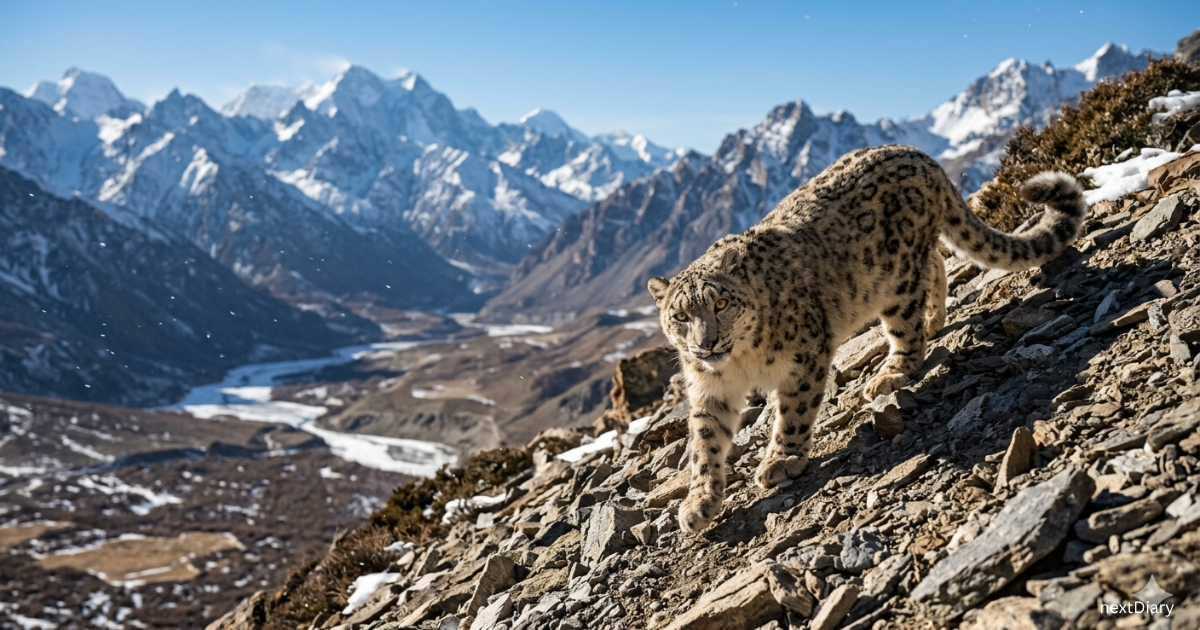

With 477 snow leopards, Ladakh holds by far the largest share of India’s population. A newly approved conservation society, SHAN, is meant to safeguard not just the cat, but the cold desert ecosystems and communities that live alongside it.
On 16 June, in Leh, Ladakh’s administration approved a new institution with an unwieldy name and a rather weighty brief. The Snow Leopard and High-Altitude Nature Conservation Society, or SHAN, is supposed to help protect the “ghost of the mountains” across India’s highest Union Territory. More interestingly, it is also meant to protect everything the cat depends on: prey, wetlands, alpine grasslands, and the brittle cold-desert ecology that is beginning to feel the full pressure of a warming Himalaya.
At first glance, this is the sort of administrative announcement that can disappear into the bureaucratic weather. A society is constituted. A lieutenant governor signs off. Committees are formed. Yet Ladakh is not just any mountain landscape, and the snow leopard is not just another flagship species.
India’s first nationwide Snow Leopard Population Assessment, released in 2024, estimated the country’s total at 718 animals. Ladakh alone accounted for 477 of them, roughly two-thirds of India’s known population. In other words, if the country wants to keep its snow leopards, Ladakh is where that ambition either stands up or quietly falls apart.
Why Ladakh matters so much
Snow leopards are easy to romanticise and difficult to conserve. They live at altitudes where the air thins, winter bites hard and fieldwork becomes a logistical punishment. Their range in India stretches across Ladakh, Himachal Pradesh, Uttarakhand, Sikkim, Arunachal Pradesh and Jammu and Kashmir, but Ladakh is the clear centre of gravity. The 477 animals recorded there compare with 124 in Uttarakhand and 51 in Himachal Pradesh.
That matters because snow leopards are what conservationists call an umbrella species. Protect enough habitat, prey and ecological connectivity for a big cat that can roam vast tracts of rock, scree and high pasture, and a good deal else benefits too. Blue sheep, ibex, Tibetan wolf, alpine plants, high-altitude wetlands, even the snowmelt-fed systems that underpin local water security all sit under the same broad ecological canopy.
“The snow leopard is a key indicator of the health of the Trans-Himalayan ecosystem,” Ladakh officials said in announcing SHAN. That can sound like familiar official language, but in this case it is fair enough. A snow leopard population does not hold up in isolation. It depends on prey populations, grazing pressure, intact travel corridors and a working relationship with the people whose livestock occupy the same valleys.
What SHAN is supposed to do
According to the Ladakh administration and subsequent reports, SHAN is intended as a dedicated institutional mechanism for wildlife conservation, biodiversity management and community-led environmental stewardship. Its remit goes beyond snow leopards to alpine fauna and flora, wetlands and fragile cold-desert ecosystems. Officials say it will support habitat protection, eco-development in snow leopard landscapes, sustainable livelihood opportunities and conservation planning rooted in science.
The composition of the society suggests the administration wants it to look broad-based, and perhaps to function that way too. Vinai Kumar Saxena, Ladakh’s Lieutenant Governor, will chair it. Ex-officio members include Ladakh’s chief secretary, the region’s MP, the chief executive councillors of the Ladakh Autonomous Hill Development Councils in Leh and Kargil, and the principal secretary of the Department of Forest, Ecology and Environment.
The non-official members are notable. They include Sejal Worah, programme director at WWF-India; Sandesh Kadur, wildlife filmmaker and explorer trustee on the National Geographic Society Board of Trustees; Palga Rinpoche, head of Naljorling Monastery; the president of the Women’s Alliance of Ladakh; and Ghulam Mohammad Khan, chairman of the Ladakh Centre for Peace and Sustainable Development.
That mix matters. Snow leopard conservation in Ladakh has never been simply a matter for biologists with camera traps. It has involved monasteries, village leaders, women’s groups, homestay owners, herders and tour operators, all trying to navigate the uneasy space between predator conservation and pastoral livelihoods.
The policy problem behind the cat
This is where the story becomes more interesting than a new society with a neat acronym.
Snow leopard conservation in India already sits within an existing policy architecture. The species receives the highest level of legal protection under the Wildlife (Protection) Act, 1972. It is also central to Project Snow Leopard, launched by the Government of India in 2009 to promote landscape-level conservation in the high Himalaya, rather than relying solely on fenced or isolated protected areas. The 2024 population assessment was part of that longer effort to replace guesswork with a baseline.
So the obvious question is this: if the policy framework already exists, what exactly is SHAN for?
The answer, at least in theory, is that Ladakh needs an institution able to join up science, funding and local delivery in one place. Project Snow Leopard set the broad direction, but implementation in mountain landscapes is often scattered across departments, donor projects and short funding cycles. A dedicated society can, in principle, mobilise resources, commission monitoring, support conflict-mitigation work and give continuity to programmes that would otherwise depend on whichever officer happens to be in post.
That is the promise. The risk is that SHAN becomes another layer of governance in a landscape already rich in committees and poor in administrative slack.
Conservation here is really about coexistence
Anyone who has spent time in snow leopard country knows that the cat is only one part of the argument. The harder question is how to keep local tolerance intact when the costs of coexistence fall unevenly.
A snow leopard slipping into a corral can kill multiple goats or sheep in a single night. For a household in a remote valley, that is not an abstract biodiversity issue but a direct economic blow. Ladakh’s conservation model has gradually shifted in response, towards predator-proof corrals, livestock insurance, compensation schemes and community-based tourism that gives the presence of snow leopards an economic value beyond the occasional missing goat.
This is where people such as Sejal Worah of WWF-India and local civil society groups matter. Ladakh has been one of India’s most important testing grounds for community-based snow leopard conservation, including homestay networks and local stewardship schemes that aim to make wildlife worth more alive than dead. None of that removes conflict. It does, however, lower the odds of retaliatory killing.
SHAN’s emphasis on “community-led environmental stewardship” suggests the administration understands this much. Whether it can sustain that work, especially when tourism, infrastructure and water stress are all rising at once, is another matter.
Climate change is the shadow over the whole plan
There is a temptation, with charismatic mountain predators, to write as though the main threat is poaching or direct persecution. Those remain real concerns. But in Ladakh the longer, slower danger is ecological change.
This is a cold desert where water is already a delicate calculation. Snowfall patterns are shifting. Glaciers are retreating. Pastures, wetlands and seasonal water availability are under pressure. Ladakh’s own administration has recently launched separate ecological restoration and water-security projects, including land restoration near Spituk and a snow-harvesting initiative called Project Him Sarovar. That is revealing in itself. The government appears to understand that conservation here cannot be separated from hydrology and land degradation.
For snow leopards, climate change is not an abstract backdrop. It can alter prey distribution, grazing patterns, vegetation cover and the seasonal use of valleys by both people and livestock. It can also intensify the competition for space and water that makes coexistence harder in the first place.
In that sense, SHAN is not really a snow leopard story at all. It is a mountain governance story with a snow leopard at its centre.
What happens next
The real test will be dull, practical and decisive. Will SHAN have a ring-fenced budget, or merely a mission statement? Will it commission regular scientific monitoring and publish the results? Will local communities see quicker compensation, better livestock protection and a genuine say in how conservation money is spent? And will the society be allowed to say no when road-building, tourism pressure or poorly planned development collides with habitat protection?
The early signs are mixed in the way such things often are. The society’s membership is serious. Its remit is broad enough to be useful. And Ladakh, given its disproportionate importance to India’s snow leopard population, probably does need a dedicated institution rather than another loose coalition of good intentions.
But mountain conservation has a habit of looking elegant on paper and untidy on the ground.
For now, SHAN is a promise made in Leh. Whether it becomes a functioning conservation institution, or simply another acronym in the Himalayan air, will depend on what follows the announcement: money, field staff, local trust, and the willingness to protect not only a famous cat, but the less photogenic business of pasture, prey and water.
The snow leopard, as ever, will be the easy part to admire. The harder task is keeping intact the landscape that allows it to remain almost unseen.